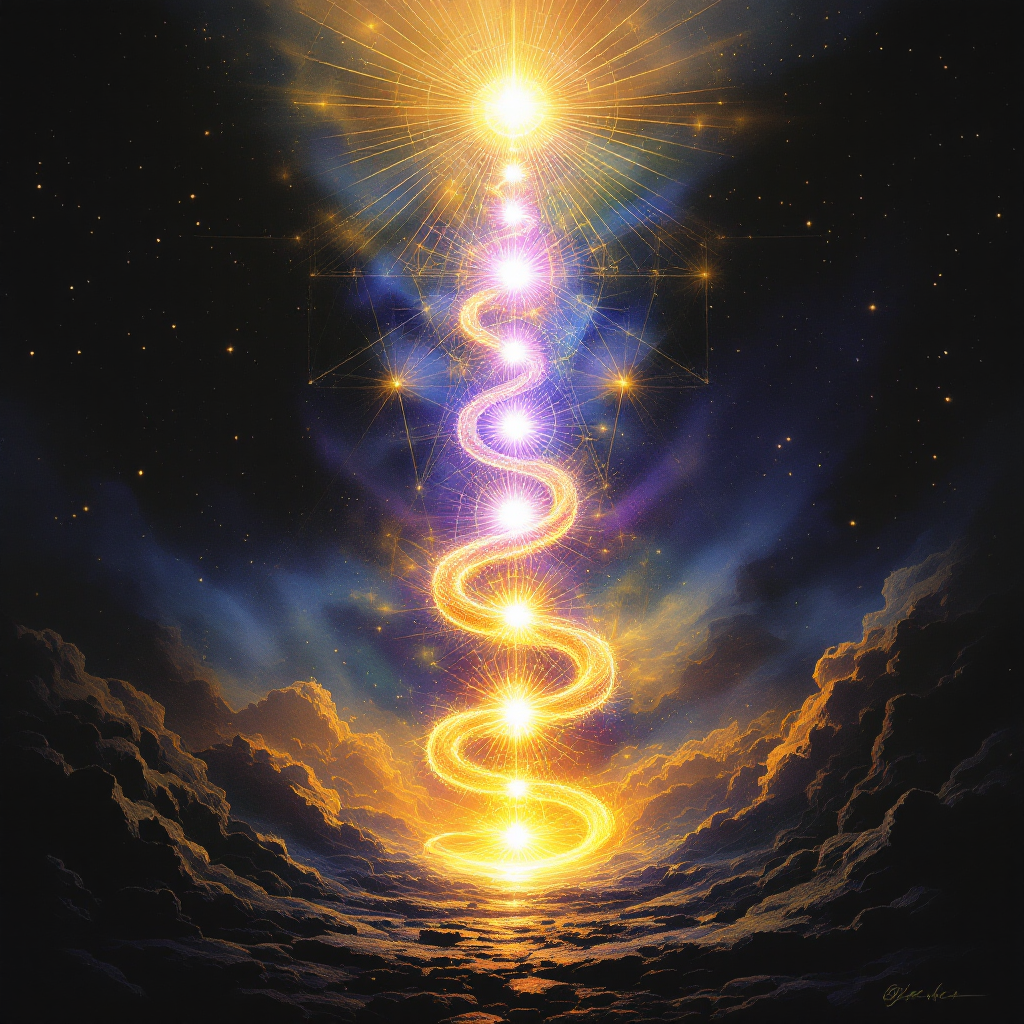
What is kundalini? In its simplest form, kundalini is a dormant spiritual energy described in yogic traditions as coiled at the base of the spine like a sleeping serpent. When awakened through discipline, breathwork, meditation, and inner purity, this serpent fire rises through the central channel of the spinal column, activating each energy center along its path until it reaches the crown of the head, triggering states of expanded awareness, divine union, and profound transformation. The Sanskrit word kundalini means “coiled one,” and for thousands of years, yogis, mystics, and initiates have mapped this inner current as the biological pathway to enlightenment.
Yet kundalini is far more than an abstract spiritual concept. It is a physiological process encoded into the human body, one that ancient traditions preserved in symbol, ritual, and sacred text long before modern science had language to describe what they were observing. The spinal column, with its 33 vertebrae, serves as the ladder this energy climbs. The chakras, the seven primary energy centers aligned along the spine, are the gates through which kundalini passes, purifying and activating each level of consciousness as it ascends.
The Serpent Symbol Across Cultures
Before the serpent was cast as a deceiver in the Garden of Eden, it was sacred. Across ancient cultures, the serpent symbolized healing, wisdom, divine power, and the very architecture of life itself. In Sumerian myth, Enki, the god of water and consciousness, was deeply associated with serpents and credited with shaping humanity. In Egypt, the uraeus cobra worn at the pharaoh’s brow signified activated inner sight and divine authority. In Greece, the caduceus of Hermes displayed two serpents spiraling around a central staff, a pattern that would later be recognized as mirroring the double helix structure of DNA.
The serpent was not merely a creature. It was a cipher, representing both the biological script of life and the spiritual force capable of awakening it. When we ask what is kundalini, we are asking about this universal current that every major tradition recognized under different names: the Djed pillar in Egypt, Jacob’s ladder in Hebrew mysticism, the Tree of Life in Kabbalah, the dragon fire in Taoist alchemy. The symbol changed across borders and centuries, but the anatomy it encoded remained constant.
The Anatomy of Kundalini: Spine, Chakras, and Channels
Understanding what is kundalini requires understanding the subtle anatomy through which it moves. The human spine contains exactly 33 vertebrae, forming the sacred staircase kundalini must ascend. This is not coincidence. Every initiatory tradition that preserved this teaching, from Hindu tantra to Egyptian mystery schools to the unified framework of sacred knowledge, recognized the spine as the central axis between earth and heaven, matter and spirit, survival and transcendence.
At the base of this column, in the region of the sacrum (whose very name comes from the Latin os sacrum, meaning “sacred bone”), kundalini lies dormant. Yogic texts describe it as coiled three and a half times, resting in the root chakra known as Muladhara. When conditions are right, discipline applied, and the vessel purified, this coiled energy begins to stir and rise.
The path upward follows the central channel called sushumna, flanked by two subsidiary currents: Ida on the left (lunar, cooling, feminine) and Pingala on the right (solar, heating, masculine). These twin currents spiral around the central axis like the serpents on the caduceus, crossing at each of the seven major chakras. When kundalini rises, it does not move in a straight line. It weaves, integrating polarity at every level, balancing masculine and feminine, logic and intuition, structure and flow, until the system achieves what the ancients called coherence and what modern science is beginning to recognize as synchronized brainwave states and heart-brain entrainment.
The Seven Gates of Ascent
Each chakra represents a distinct stage of consciousness and a specific domain of human experience. As kundalini rises, it activates and purifies each center in sequence:
Root (Muladhara): Survival, grounding, physical safety. The base instinct. When kundalini awakens here, the seeker begins to master fear and stabilize the foundation.
Sacral (Svadhisthana): Creativity, desire, procreation. The generative fire. Kundalini refines this energy, transmuting appetite into creative expression and sacred vitality.
Solar Plexus (Manipura): Willpower, identity, personal power. The seat of the ego. Here kundalini confronts control, fear of failure, and the hunger for dominance. Only when the ego surrenders does the fire continue upward.
Heart (Anahata): Love, compassion, balance. The integrator. Kundalini cannot rise beyond this gate if the heart is closed, bitter, or fragmented. This is where polarity reconciles, where forgiveness becomes possible, and where the journey shifts from personal to universal.
Throat (Vishuddha): Expression, truth, communication. The voice aligned with integrity. Kundalini activates the capacity to speak truth without fear and to listen without defensiveness.
Third Eye (Ajna): Intuition, vision, inner sight. The lamp of the body. When kundalini reaches this center, perception expands beyond the five senses. The pineal gland, long regarded as the seat of the soul, begins to activate. What scripture called “the single eye” and yogis called the command center becomes a gateway to direct knowing.
Crown (Sahasrara): Divine union, transcendence, illumination. The thousand-petaled lotus. When kundalini reaches the crown, the individual self dissolves into universal consciousness. This is not death but completion. The serpent fire has climbed the full ladder, and the seeker experiences what mystics across traditions have called samadhi, nirvana, Christ consciousness, or simply the light within.
What Awakens Kundalini?
Kundalini does not awaken by accident, though spontaneous risings have been documented throughout history. Most often, awakening requires deliberate preparation: purification of the body through fasting and clean diet, regulation of the breath through pranayama, stilling of the mind through meditation, and the redirection of generative energy upward rather than outward. Sexual restraint, particularly during periods of intensive practice, is emphasized across traditions not as moral prohibition but as energetic conservation. The same vital essence that creates life externally can, when preserved and refined, ignite illumination internally.
The practices vary by lineage, but the principles converge. Dietary purity and the rejection of inflammatory foods prepare the vessel. Breathwork moves the current deliberately, using rhythm and retention to guide energy through the spinal channel. Meditation quiets the mental noise that scatters the ascending fire. And sacred timing, often aligned with lunar cycles or astrological windows, creates the resonant conditions under which the body’s own chemistry shifts into the elevated state required for ignition.
The exact sequence of practices, the breath ratios, the fasting windows, and the lunar timing protocols are detailed in the complete framework preserved in Master Thyself, where the biological mechanism behind kundalini activation is mapped onto the body’s endocrine system, cerebrospinal flow, and the sacred secretion known in mystical traditions as the Christos oil.
The Symptoms and Signs of Kundalini Rising
Those who have experienced kundalini awakening describe a range of physical, emotional, and perceptual phenomena. Some report intense heat or energy moving up the spine. Others experience spontaneous trembling, kriyas (involuntary movements), or waves of bliss. Inner lights, geometric visions, and a sense of vast interconnectedness are common. Deep emotional release, the surfacing of buried trauma, and waves of unconditional love or grief can accompany the process.
Not all awakenings are gentle. When kundalini rises through a vessel that has not been adequately purified, the results can be destabilizing: insomnia, sensory overload, emotional volatility, disorientation, and what some modern practitioners call kundalini syndrome. This is why every tradition that preserved this teaching also preserved a warning: purify before you activate. Kundalini does not distinguish between the prepared and the unprepared. It simply rises. The preparation is not optional. It is the point.
Kundalini and the Christos Oil
What is kundalini in the context of Western mysticism? The same inner fire, encoded under different symbols. In early Christian esotericism, the sacred secretion known as Christos oil descends from the brain and, when preserved through fasting, purity, and discipline, ascends the spinal column to illuminate the pineal gland. This is the biological resurrection, the inner anointing that transforms the vessel into a temple of living light. The kundalini serpent and the Christos oil are not separate teachings. They are the same physiological process described in different languages.
The spine is the ladder. The chakras are the rungs. The sacred fluid, whether called kundalini shakti or cerebrospinal essence, is the current that rises. At the crown, when pineal and pituitary unite in what mystics called the sacred marriage, the body produces what ancient texts described as milk and honey, the nectar of immortality, the soma of the gods. This is not metaphor. Modern endocrinology confirms that the pineal gland secretes melatonin and potentially other compounds under specific conditions, while the pituitary governs growth, regeneration, and hormonal balance. When these two glands harmonize, the entire system enters a state of coherence that resembles what yogis have described for millennia.
The Demonization of the Serpent
If kundalini is the human birthright, the biological pathway to sovereignty and direct communion with the divine, why was the serpent demonized? The answer lies in control. A population awakened to its own inner divinity does not require priests, kings, or institutions to mediate access to God. When the serpent was recast as Satan in the Garden of Eden, it wasn’t theology. It was strategic suppression. To demonize the serpent was to sever humanity from the very map of its own liberation.
The inversion was thorough. Institutions that claimed divine authority suppressed the knowledge of inner awakening, burning texts, silencing mystics, and driving the teaching underground into mystery schools, esoteric orders, and oral lineages that survived only through secrecy. The serpent, once the symbol of healing and wisdom, became the archetype of temptation and fall. Yet the map was never destroyed. It was encoded in scripture, in temple architecture, in fairy tales, and in the human body itself, waiting for those with eyes to see.
Kundalini in Modern Practice
Today, kundalini yoga has entered mainstream wellness culture, often stripped of its esoteric depth and repackaged as fitness or stress relief. While breathwork, movement, and meditation can offer genuine benefit, the full tradition is initiatory, not recreational. True kundalini practice is not about flexibility or relaxation. It is about transformation. It is ego death, cellular purification, and the reorganization of consciousness at every level.
Modern seekers often approach kundalini with curiosity but without the disciplined preparation ancient lineages required. The result can be partial awakenings, energetic imbalances, or the triggering of latent trauma without the container to integrate it. This is why lineage matters. A qualified teacher, one who has walked the path and stabilized their own system, can guide the process safely. Without guidance, the seeker risks scattering the current or collapsing under the intensity of what rises.
That said, the teaching was never meant to remain locked in ashrams or reserved for renunciates. Kundalini is the inheritance of every human being. The architecture is already present. The question is not whether you have access. The question is whether you are willing to discipline yourself, purify the vessel, and walk the inner ladder one rung at a time.
The Hidden Science of Kundalini
Modern neuroscience is beginning to map what the ancients described symbolically. The vagus nerve, the longest cranial nerve in the body, connects the brainstem to the heart, lungs, and digestive organs, regulating the parasympathetic nervous system and influencing states of calm, digestion, and immune response. Stimulation of the vagus nerve has been shown to reduce inflammation, improve heart rate variability, and shift brainwave patterns toward coherence. Yogis called this the sushumna. Science calls it the vagal pathway. Same channel, different century.
Cerebrospinal fluid pulses through the brain and spinal column with every breath, carrying hormones, neuropeptides, and signaling molecules. When breath is regulated through pranayama, CSF flow changes, intracranial pressure shifts, and the pineal gland’s piezoelectric crystals can emit photons, internal light, under mechanical stimulation. The glymphatic system, discovered in 2012, shows that CSF actively flushes metabolic waste during sleep and fasting, supporting brain renewal and neurogenesis. The sacred secretion pathway the mystics described is verifiable in any medical textbook. The biology was always there. The traditions simply lacked the vocabulary to name it in clinical terms.
Kundalini and DNA Activation
What science once dismissed as junk DNA may be dormant code awaiting activation. Non-coding regions of the genome, long ignored as evolutionary debris, are now understood to regulate gene expression, influence epigenetic markers, and respond to environmental signals. When kundalini rises and the body enters states of deep coherence, what changes? Gene expression shifts. Telomeres stabilize. Inflammatory markers drop. The body’s own repair mechanisms activate at levels beyond baseline function.
The double helix of DNA mirrors the twin serpents of the caduceus. The central axis of the spine mirrors the staff they coil around. The ancients encoded the map of life into their most enduring symbols, not as decoration but as instruction. When the serpent fire rises, it does not merely elevate mood or expand perception. It activates latent genetic potential, the dormant faculties written into human design but suppressed by millennia of fragmented living, toxic exposure, and survival-mode consciousness.
The Path Forward
So what is kundalini, ultimately? It is the biological mechanism of ascension, the ladder built into your own spine, the current that transforms survival consciousness into divine awareness. It is the serpent that was never evil, the fire that was never foreign, the light that was always within. Every tradition that preserved it pointed to the same truth: you are the temple, the spine is the pillar, and the path to God runs through your own body, not through any institution, ritual, or external savior.
The awakening is not reserved for saints or yogis. It is the inheritance of every human being willing to forsake distraction, purify the vessel, and climb the inner staircase one conscious breath at a time. The gates are already there. The current is already present. What remains is the choice: to live scattered in appetite and ego, or to gather the fire inward and let it rise.
Kundalini is not the end of the journey. It is the beginning of remembering who you were before the fall, before the forgetting, before the serpent was cast as the enemy. It is the return to coherence, vitality, and the direct knowing that no authority can grant and no institution can revoke. The map was written into your bones. The key is your own discipline. The kingdom, as it was always said, is within.