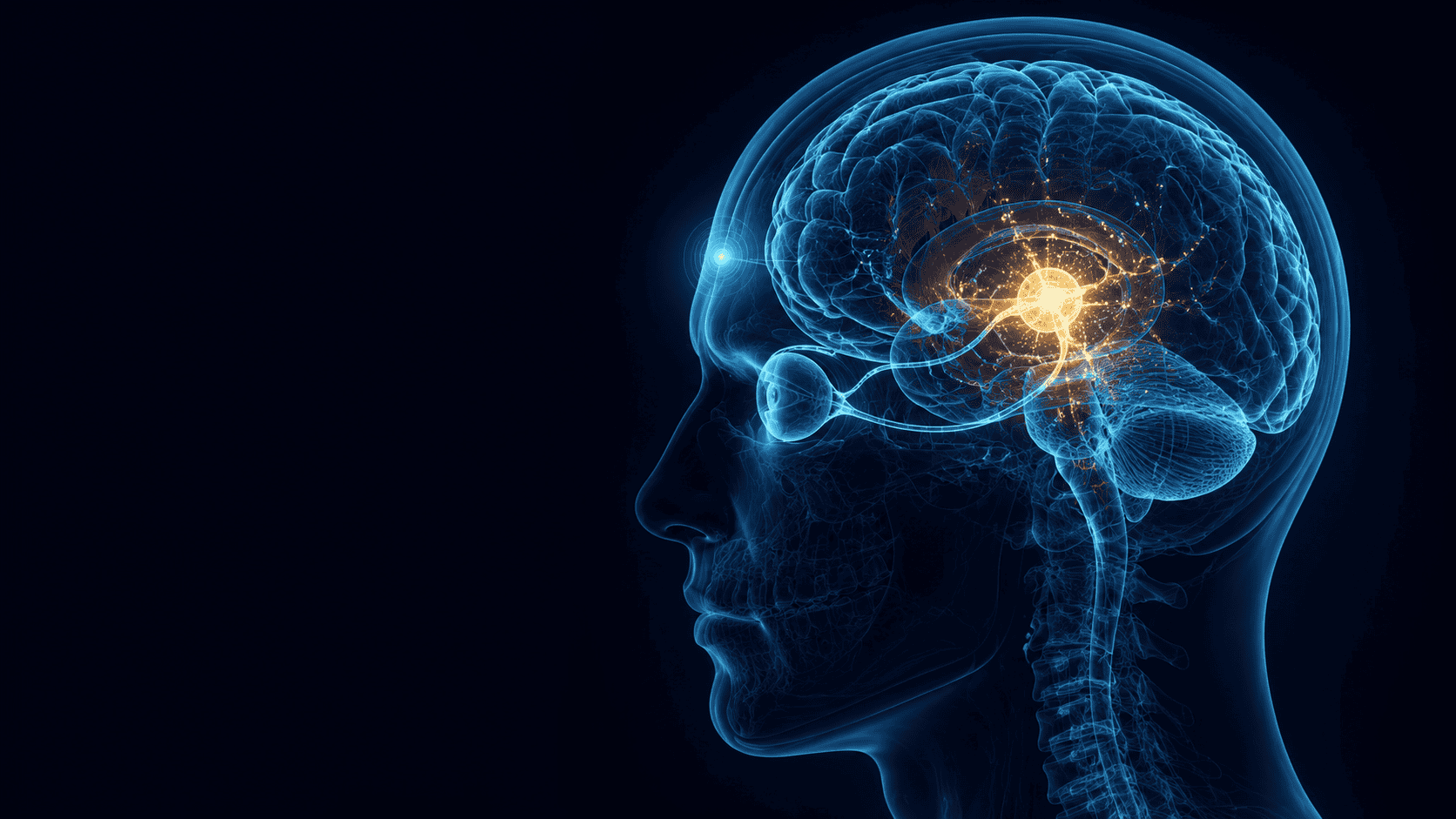
decalcification of the organ
The third eye. The seat of the soul. The Eye of Horus. The same gland, drawn into every sacred symbol, in every culture, for thousands of years.
the inner-light practice is the deliberate recovery of an anatomically real organ that almost every modern adult has, to some degree, allowed to calcify. If you searched this awakening process, you have probably been told it is a chakra exercise, a meditation practice, or a metaphor. The pineal gland is none of those. It is a real piece of tissue at the geometric center of your skull, and the protocol that recovers its function is specific, sequenced, and well-documented across traditions that almost nobody on the modern internet has bothered to integrate. The full protocol is in the book.
What is opening this organ?
A small piece of tissue at the geometric center of the brain. Not metaphor. Not vestigial. The literal structure every tradition was pointing at.
What modern medicine acknowledges
the awakening practice begins with understanding what the gland actually is. The pineal is a small, pinecone-shaped endocrine gland sitting at the geometric center of the brain. It is the only unpaired structure in the brain. Every other brain region has a left and right counterpart. The pineal does not. It sits alone, dead-center, on the midline.
Modern medicine credits it with one main job: producing melatonin, the hormone that regulates the sleep-wake cycle. That is the small version of the story. The gland connects to the visual system through the optic chiasm. It responds to light. It contains photoreceptor-like cells. It plays roles in seasonal biology, pubertal timing, and circadian rhythm regulation that are still being unpacked. Even the modern textbook treats it as a special structure.
What every other tradition called it
The Vedic tradition called it the ajna chakra, the third eye. Buddhist iconography places the bindi exactly where the pineal sits. Egyptian mystery schools encoded it as the Eye of Horus. The Hellenic and Hindu traditions both used the pinecone as its symbol. The Vatican has a giant bronze pinecone in its central courtyard. Bacchus carries a pinecone-tipped staff. The staff of Osiris is a pinecone with two serpents.
Descartes called it the seat of the soul. The Hermetic tradition called it the single eye. The Christian gospels reference "the light of the body is the eye, if therefore thine eye be single, thy whole body shall be full of light." Every tradition independently encoded the same anatomical structure in their sacred art. The agreement is not coincidence. It is evidence. And every tradition agreed that this inner-light protocol was the goal of the practice.
Why the activation work matters now
Imaging studies confirm what almost no spiritual teacher mentions. Pineal gland calcification is widespread, environmental, and accelerating.
The data is not contested. Imaging studies on adults in industrialized countries find calcium deposits in the pineal gland in the majority of subjects past age forty, and in a significant fraction of children. Calcification scores increase with age, with industrial exposure, and with proximity to fluoridated water supplies. This was not the historical baseline. Studies of skeletal remains and older imaging records show much lower rates of pineal gland calcification in populations preceding the industrial era.
The mechanisms are clinically documented. Fluoride accumulation is the most studied: the pineal gland concentrates fluoride at higher rates than any other soft tissue in the body. Processed and refined foods, environmental endocrine disruptors, chronic blue-light exposure, and the cumulative load of low-grade industrial toxins all contribute. Each one moves the needle. The combined effect is a pineal that has, over decades, crystallized toward something closer to bone than gland. decalcifying the organ in a calcified gland is structurally impossible. The instrument has to work first.
The implications are direct. The gland that was supposed to receive the sacred secretion at the top of the cascade has been quietly turning to stone, in most modern people, since childhood. Every meditation practice, every fast, every kundalini exercise, every spiritual technique on every page of this site or any other site, is delivering a fraction of its potential output if the receiver is calcified. Almost nobody addresses this. Pineal gland activation as it is taught online is missing this entire prerequisite. For the timing layer that still pairs with the gland, see the sacred secretion calendar.
The full mechanism of calcification, the rate of accumulation, and the specific reversal protocol for pineal gland activation are mapped in Chapter 14 of Master Thyself. Not on this page. The protocol is in the book.
Get the Book ↓Six places pineal gland activation is encoded in sacred art
The agreement across traditions is the strongest evidence that ancient cultures understood third eye activation centuries before modern medicine had a name for the gland.
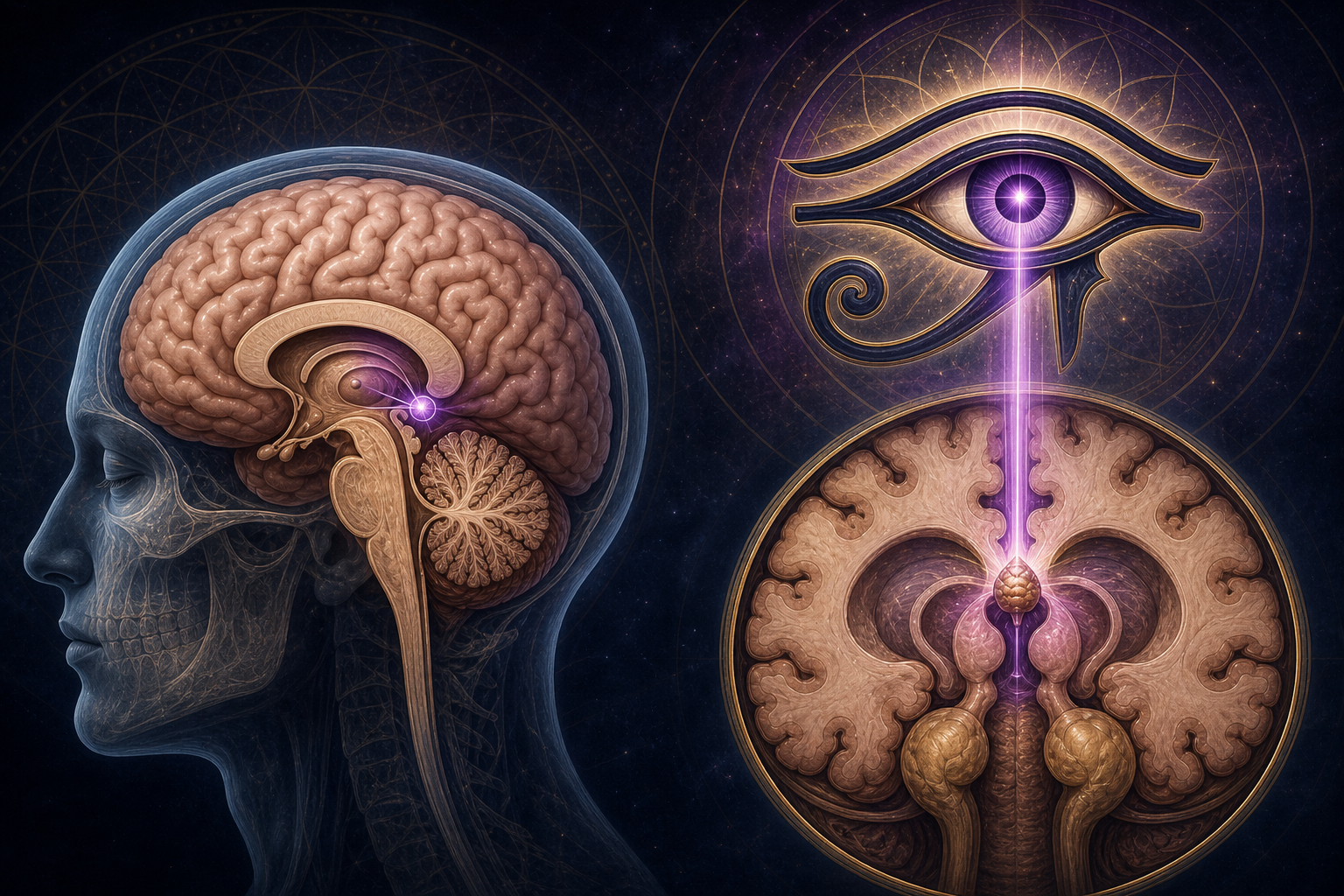
The image above pairs the Egyptian Eye of Horus with a sagittal cross-section of the human brain, the same anatomical region, two thousand years apart, drawn by people who could not have known what an MRI shows. Every culture that took inner work seriously left its understanding of pineal gland activation in its sacred imagery. The list below is six entry points. The full survey is in the book.
The most famous third-eye symbol in history. The Eye of Horus is a remarkably accurate cross-section of the human brain at the level of the pineal-thalamus complex. The eyebrow, the eye itself, the curl beneath, the spiral, all match anatomical features of the midbrain region the pineal sits in. The Eye of Horus pineal mapping is exact. The Egyptians did not have MRI machines. They knew anyway.
The pineal gland is named for its pinecone shape (Latin pinea). Bacchus carries a pinecone-tipped staff. The staff of Osiris is a pinecone with two serpents winding up it, the same caduceus we still use as the modern medical symbol. The Vatican has a four-meter bronze pinecone in its courtyard. The symbol is the gland.
The bindi sits exactly above the pineal. The ajna chakra in Vedic anatomy is placed at the center of the forehead, midway between the eyebrows, projected onto the surface from the gland's actual location inside the brain. The mapping is anatomical, not metaphorical. Eastern traditions had a description of the gland in their sacred texts long before the western anatomical tradition had a name for it.
The seventeenth-century philosopher and mathematician argued, in The Passions of the Soul, that the pineal gland was where the immaterial mind interfaced with the material body. He chose it specifically because it was the only unpaired structure in the brain. His reasoning was anatomical. Modern academia tends to treat his hypothesis as a curiosity. Modern data tends to suggest he was closer than he was given credit for.
The eye in the triangle, the capstone of the pyramid, the symbol that appears on currency, official seals, secret society regalia, and church architecture. The all-seeing eye is the third eye. The triangle is the brain's geometric structure around the gland. The capstone is the position of the pineal at the top of the central axis. The encoding is consistent across many disconnected lineages.
Royal crowns, papal mitres, the halos in religious art, the tonsures of monks, the head ornaments of every sacred figure across cultures. All of them sit exactly where the pineal sits. The symbol marks the gland. The position of the crown on the head is the position of the seventh chakra is the position of the pineal. Once you see this, you cannot unsee it.
The full cross-tradition mapping, the iconographic evidence, and the suppression history are in Chapters 11 and 12. The convergence across traditions is not the side note. It is the core of the case for pineal gland activation as a real, recoverable practice.
Read Chapters 11 & 12 →What the Skeptical Reader Should Know
A reasonable critic of this whole topic notes, correctly, that the contemporary spiritual marketplace has built an industry around claims that outrun the evidence. Most of what gets sold online overstates what is known, oversimplifies what is complicated, and rushes past the long apprenticeship the traditional schools considered nonnegotiable. The skeptic is right to be wary.
The honest response is not to dismiss the topic, but to distinguish the parts that are well-supported from the parts that are speculative. Well-supported: the small endocrine organ in question regulates the body's light-and-dark cycle, produces melatonin, and accumulates calcium phosphate over time at rates that vary measurably between individuals. The body's responsiveness to specific dietary, behavioral, and environmental inputs is documented in peer-reviewed literature. None of that is in dispute.
Speculative: that the organ has perceptual functions beyond circadian regulation, that those functions can be developed deliberately through practice, that the practice produces phenomena the contemplative traditions describe consistently. These claims have testimony from practitioners across thousands of years, convergence across cultures with no contact, and increasing tentative support from neuroimaging research, but they do not have the kind of replicated controlled-trial evidence that would settle the question. They are taken seriously by some researchers and dismissed by others.
Where this leaves a reasonable reader: the framework is worth taking seriously enough to investigate, not seriously enough to adopt without testing. The protocol is testable. Run it on yourself. Track the results. Decide what is real for you based on what you observe, not on what anyone else claims.
The full protocol, the specific sequencing, and the why behind each step are covered in the book: Redacted, Chapter 14.
Master Thyself, Chapters 13, 14, 21Read The Inner Temple →
Master Thyself
A 700-page synthesis of sacred geometry, suppressed knowledge, and the science of self-mastery. The full pineal gland activation protocol, including the specific reversal agents, the order to apply them, and the integration practice, is mapped in detail across Chapters 11, 12, 13, 14, and 22. It is not on this page. It is in the book.
Why pineal gland activation fails for most modern seekers
Modern medicine has the anatomy. Modern spirituality has the framing. Almost nobody integrates them. The integration is the work.
Modern medicine treats the pineal as primarily endocrine. It measures melatonin. It tracks circadian rhythm disruption. It treats most of the gland's broader function as either unestablished or unproven. That position is technically defensible. It is also incomplete. The pineal-pituitary axis, the gland's response to light through the optic chiasm, the photoreceptor-like cells inside it, and its role in cerebrospinal fluid signaling all suggest a much wider function than the simple sleep regulator the modern textbook describes. Pineal gland activation is not on the medical syllabus. The medical literature is starting to catch up. The mainstream framing has not.
Modern pop-spirituality treats the pineal as primarily energetic. It teaches visualizations, hand mudras, sound frequencies, and chakra meditations. Some of those work. Most are watered-down fragments of older protocols, stripped of the dietary work, the environmental discipline, and the timing instructions that made them effective in their original contexts. The energetic frame on its own produces seekers who feel they are working on the third eye while their gland calcifies further every year, because nothing in the practice addresses the calcification. Pineal gland activation without addressing the calcification is theater.
The original traditions did both. They taught the dietary protocols, the environmental discipline, the postural and breath work, the timing, and the integration practices, all of it together, as one piece. The fragmentation came later. The reintegration is the work this book exists to do. Pineal gland activation is not a meditation. It is not a supplement stack. It is not a frequency. It is all of those things, in a specific sequence, with specific markers, mapped to the actual physiology. For the broader ascent that pineal gland activation is the destination of, see kundalini awakening. For the dietary protocol that makes the reactivation possible, see biblical fasting.
The full pineal gland activation protocol, the sequence of reversal agents, the timing markers, and the integrated practice are in Chapters 14 and 22.
Read the Protocols →Three sites that complete the pineal gland activation picture
Reactivation is one piece of a larger frame. Three companion sites address the surrounding context the protocol depends on.
Fluoride, plastics, processed food, pesticides, synthetic fragrances, and the cumulative chemical load that scrambles the hormonal cascade the pineal sits at the top of. The sources of the calcification, addressed in detail. The cleanup that runs alongside pineal gland activation.
The mechanismThe optic chiasm, the cranial nerves, the endocrine cleanse, and the biology of the sacred secretion that the pineal receives. The system the gland sits at the top of.
Why this was buriedThe history of how this knowledge was systematically erased, suppressed, or recoded into mythology. Why a gland that every ancient tradition drew is treated as vestigial in the modern textbook.
Still here?
Twelve more questions on pineal gland activation.
Each thread is followed in the fuller work. None of these are answered on a typical pineal gland activation site.
Pineal gland activation is real and recoverable
Your pineal gland is real, calcified, and recoverable. Pineal gland activation is sequenced, specific, and not on this page.
The page you just read is the problem and the history. The pineal gland activation protocol is the rest of the book. The fifteen specific reversal agents, the order to apply them, the timing, the synergistic stacks, the integration with the sacred secretion calendar, Redacted, Chapter 22, and the markers of returning function: all of it lives in Master Thyself, mapped to the citations, in plain language.
If you want the actual pineal gland activation protocol, this is the only place it currently exists in one piece.