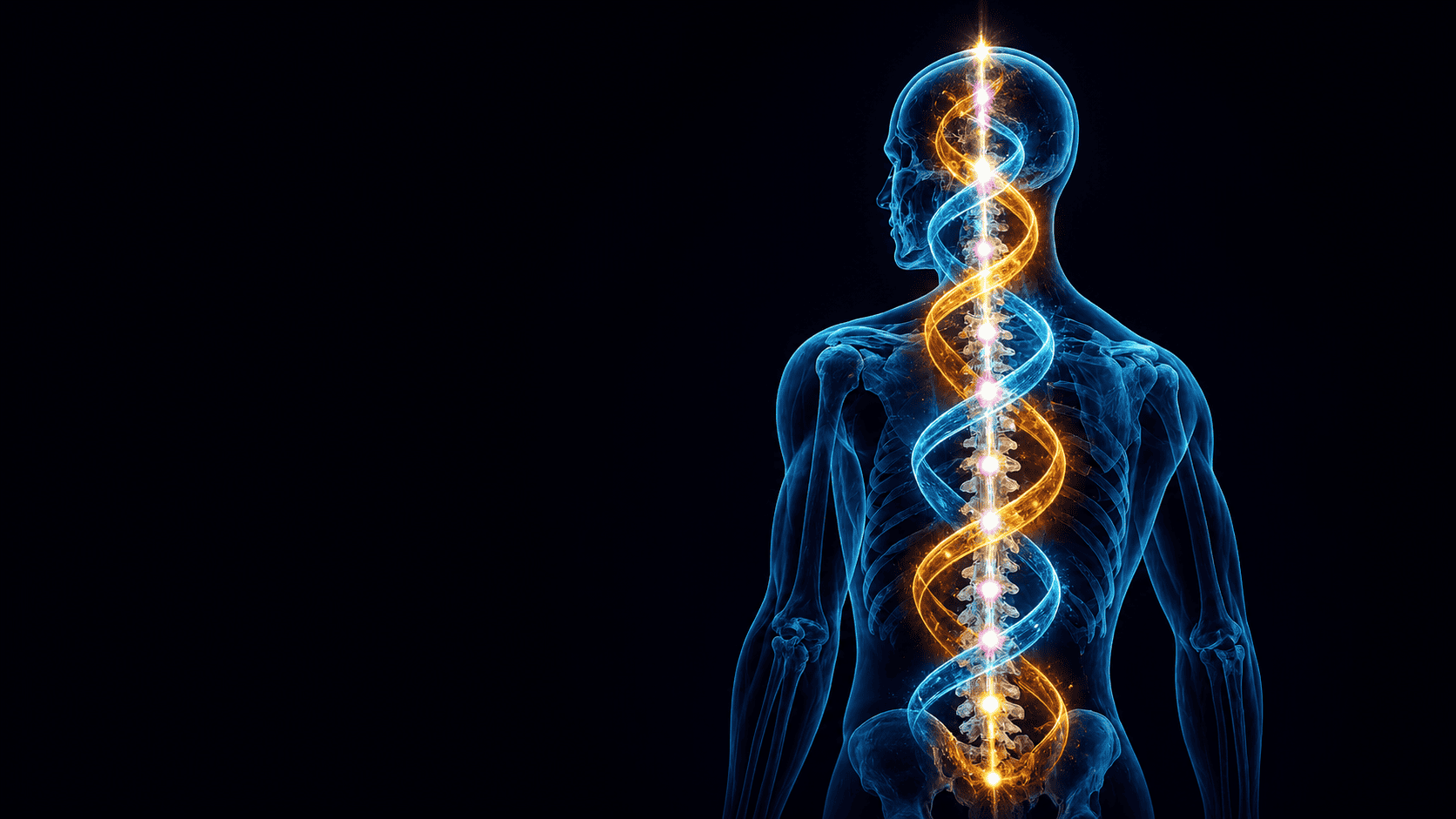
Kundalini Awakening
The serpent rising in yoga. The Holy Spirit descending in Christianity. The Christos oil ascending the spine. The same biological event, in every language.
If you searched kundalini awakening, you have probably been told it is a chakra phenomenon, an energy event, a spiritual emergency, or a metaphor. All of those frames are partial. What ancient yogic texts called the rising of the serpent is the same physiological cascade that Christian mystics called the descent of the Holy Spirit, that Egyptian priests called the ascent through the cranial nerves, and that modern neuroscience can now measure in cerebrospinal fluid dynamics, endocrine signaling, and pineal activation. The next sections give you the actual map.
What is kundalini awakening?
A real, measurable physiological cascade that every contemplative tradition encoded in different vocabulary.
The Sanskrit description
Kundalini, in the Sanskrit tradition, is described as a coiled serpent of dormant energy resting at the base of the spine. The yogic teaching holds that under specific conditions of practice, this dormant current rises through seven energetic centers (the chakras) and reaches the crown of the head, producing what the tradition calls samadhi: the dissolution of the boundary between the practitioner and reality.
This is not metaphor. The Sanskrit teachers were describing a physiological event with a measurable substrate. The current is biochemistry. The channels are anatomy. The serpent is cerebrospinal fluid following the spinal column. The crown is the pineal gland. The yogic vocabulary is correct. What gets lost in modern teaching is the biology underneath it.
What every other tradition called the same thing
Christianity called it the descent of the Holy Spirit: the divine fire entering the body and ascending. Tongues of flame above the apostles' heads at Pentecost. The Christ within. Egyptian mystery schools called it the ascent through the cranial nerves: the soul's passage up the spine through twelve gates, mirrored in the twelve cranial nerves of modern anatomy. The Hermetic tradition called it the marriage of Sol and Luna, the integration of the two cerebral hemispheres into a unified perception.
Sufism called it the rising of the secret. Jewish mysticism called it the opening of the mouth of God. Daoism called it the circulation of the golden light. Different language. Same biology. Every tradition, with its own vocabulary, was pointing at the same neurophysiological event. The agreement across traditions is the strongest single piece of evidence that kundalini awakening describes something real.
The biology every modern kundalini site leaves out
The yogic description is structurally correct. Modern neuroscience now has the instruments to confirm what the tradition was pointing at.
The first thing modern kundalini teaching gets wrong is treating the awakening as primarily an energy event. The current the yogis described is a real, measurable substance: cerebrospinal fluid. CSF is the clear liquid that bathes the brain and spinal cord, produced in the choroid plexus, circulating through the ventricles of the brain, flowing down the central canal of the spinal cord. The rising of kundalini is the moment this fluid shifts state under specific physiological conditions: Redacted, Chapter 14, Redacted, Chapter 13, and Redacted, Chapter 14.
The second thing modern kundalini teaching gets wrong is the chakra model. The seven chakras are anatomically real. They are not metaphysical wheels of light. They are the seven major endocrine glands of modern medicine. Root maps to adrenals. Sacral to gonads. Solar plexus to pancreas. Heart to thymus. Throat to thyroid. Third eye to pituitary. Crown to pineal.
Each chakra activation in classical kundalini description corresponds to a measurable hormonal event in modern endocrinology. The yogis were describing endocrine signaling, in different language. The agreement, once you align the vocabularies, is exact.
The third thing modern kundalini teaching gets wrong is treating the awakening as something that should be aggressively pursued. The classical traditions did not. They taught preparation first, awakening second. They taught dietary protocols, postural conditioning, breath work, ethical training, and years of integration before the awakening practice itself. The modern internet version often skips most of this. The result is a generation of seekers who accidentally trigger partial awakenings into unprepared nervous systems and then cannot understand why the experience does not match the literature.
The full mapping of the kundalini current to CSF dynamics, the cascade, and the brain-clearing system is in Chapter 14 of Master Thyself. The biology behind the metaphor.
Read Chapter 14 →Three traditions, one image. The pattern at the heart of kundalini awakening.
The Sanskrit kundalini diagram, the Greek caduceus, and the modern DNA double helix all show the same structural pattern. Three traditions. Three eras. One image. The agreement is not coincidence.
Two intertwining currents wound around a central axis. This is the structural pattern at the heart of every kundalini awakening account on record. The Sanskrit yogic tradition called the central column the Sushumna and the two helical currents Ida and Pingala. The classical Greek tradition called the same image the caduceus, the staff of Hermes that became the modern symbol of medicine. Modern molecular biology calls it the DNA double helix. Three traditions. Three eras. The same image.
The kundalini awakening literature describes the rising of the serpent. Sanskrit explicitly used two serpents winding around the spinal pillar. The image is not metaphorical decoration. It is anatomical description. The two helical currents map to the body's two autonomic nervous system branches: the sympathetic (Pingala, solar, masculine, activating) and the parasympathetic (Ida, lunar, feminine, restorative). The central pillar is the spinal cord itself, the literal pathway cerebrospinal fluid travels during the kundalini awakening cascade.
The caduceus carried the same encoding. Hermes' staff, two serpents intertwined around a central rod, was the symbol of healing in the classical world long before it became the sigil of modern medicine. The Greeks did not have MRI. They were not modeling DNA. They were drawing the same anatomical structure the Sanskrit tradition was drawing, half a world away. The kundalini awakening pattern was already the symbol of medicine in 500 BC.
The DNA double helix completed the picture in 1953. Watson and Crick's structure, two intertwining strands wound around an axis, is the same image. Modern biology arrived at the diagram the kundalini awakening tradition had been drawing for thousands of years. The agreement is not coincidence. It is convergent evidence that the body has a real, measurable pattern of two helical currents around a central axis, and that traditions which had no contact with each other independently identified it.
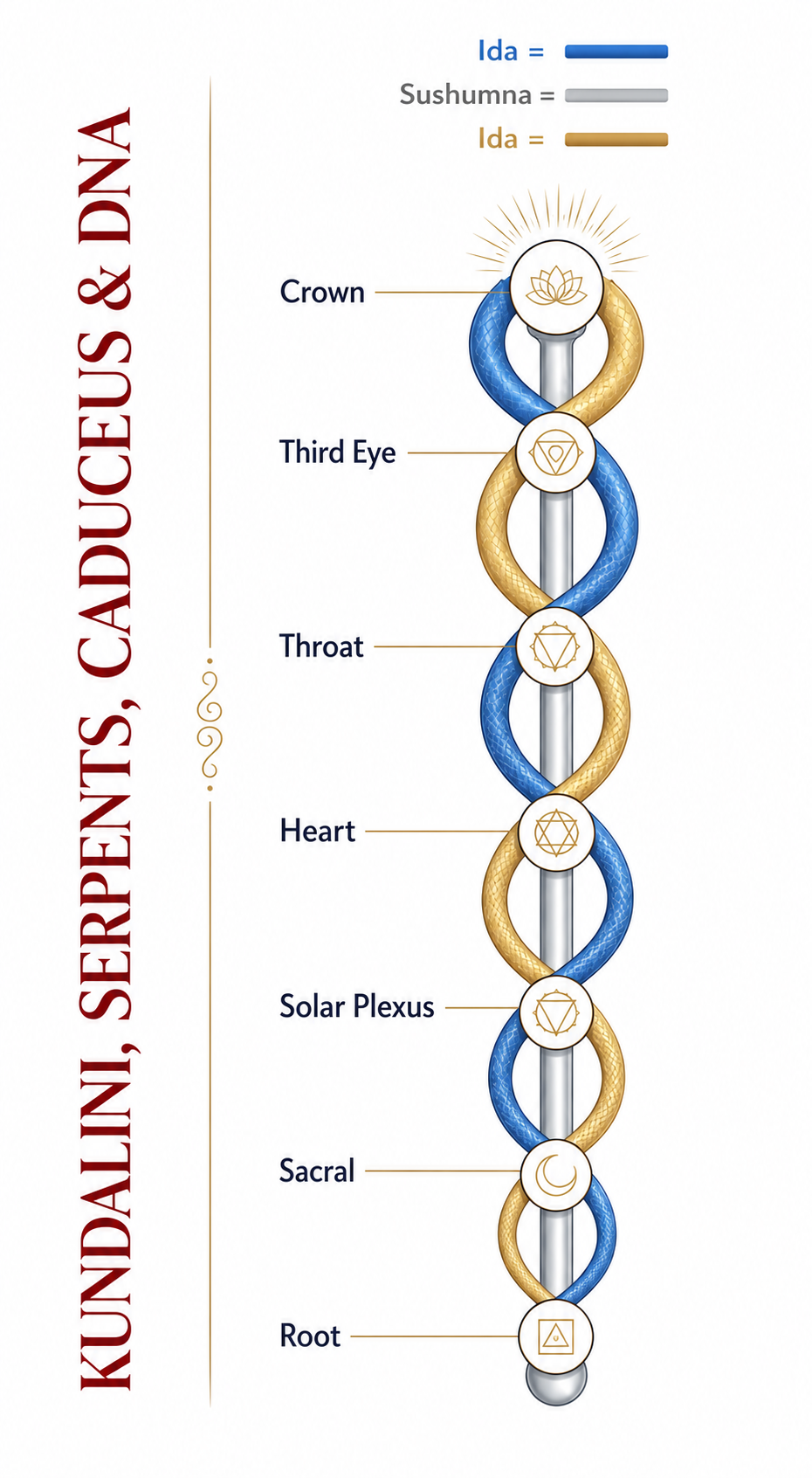
The kundalini awakening pattern. Ida (blue), Pingala (gold), Sushumna (white). The caduceus, the DNA helix, and this diagram are the same image.
A reasonable response to this convergence: if three independent traditions, separated by centuries and continents, all drew the same image of two intertwining currents around a central axis, the most likely explanation is that the image is real. The kundalini awakening cascade, as the modern internet describes it, is a partial fragment of a phenomenon every contemplative tradition independently mapped. The Christian descent of the Holy Spirit, the Egyptian ascent through the cranial nerves, the yogic kundalini awakening: different vocabulary, same biology.
The full kundalini awakening cascade, mapped to the anatomical structures the caduceus, the DNA helix, and the Sushumna all encode, is in Chapter 14.
Get the Book ↓The full protocol, the specific sequencing, and the why behind each step are covered in the book: Redacted, Chapter 21.
Master Thyself, Chapter 21Read The Christos Oil →
Master Thyself
A 700-page synthesis of sacred geometry, suppressed knowledge, and the science of self-mastery. The full kundalini awakening framework, mapped to peer-reviewed endocrinology and neuroscience, is woven through Chapters 13, 14, 20, 21, 22, and 23. The cross-tradition picture is in this book.
The seven stages of kundalini awakening
Each stage corresponds to a specific endocrine gland activation. The yogic map is the medical map. The names are different. The physiology is identical.
The current rises from the base. The adrenal glands recalibrate. The body's stress response shifts from chronic fight-or-flight toward parasympathetic stability. Practitioners report a sense of grounded presence and the dissolution of low-grade anxiety. This is the foundation. Most modern adrenal exhaustion is what blocks this stage from ever completing.
The current passes the gonads. Hormonal signaling shifts. Sexual energy stops being a mere reproductive drive and begins to be perceived as a current with directionality. The yogic instruction to abstain during practice is the instruction to redirect this current upward rather than discharging it. The classical traditions all agreed on this, in different vocabularies.
The current reaches the pancreas. Blood sugar regulation shifts. The diaphragm and abdominal cavity become noticeably warmer. Practitioners often experience this as fire in the belly or the activation of personal will. The traditional description is exactly the physiological reality. Heat, will, and metabolic recalibration are the same event in different vocabularies.
The current passes the thymus. Immune signaling reorganizes. The chest becomes the locus of perception. The opening of the heart that classical traditions describe is the activation of vagal tone and thymic immune-regulatory output. This is when the ego boundary becomes permeable to other beings. The compassion described in the literature is not sentiment. It is neurology.
The thyroid recalibrates. Metabolic baseline shifts. Voice quality often changes. The yogic instruction that truth begins to flow as the throat chakra opens reflects the metabolic shift toward clarity and the dropping of self-protective speech patterns. Practitioners report saying things they had been holding back for years, and meaning them.
The pituitary, the master gland of the entire endocrine system, comes online in a new way. Hormone cascades that had been suppressed activate. Visual perception sharpens. Inner imagery intensifies. The pineal-pituitary axis is now signaling at full capacity. Many traditions place this as the second-to-last stage because it is the gland that orchestrates the final activation.
The current reaches the pineal. Endogenous DMT, melatonin precursors, and other neurochemicals release in a cascade that produces what every tradition has called illumination. This is the event. Everything before this stage was preparation. Most modern people never reach this stage because their pineal is calcified. The instrument is shut. The current arrives, and there is nothing for it to ring.
The full seven-stage protocol, including the gland-by-gland preparation work and the markers for each transition, is mapped across Chapters 13, 14, 21, and 22.
Read the Protocols →How to awaken kundalini without breaking yourself
Most online instructions are either too vague to be useful or too aggressive to be safe. The corrected practice is sequential. Each phase has specific physiology. Each protocol has its specific outcome.
The first instruction is do not start with kundalini. Start with the prerequisites. A kundalini awakening into a calcified pineal, exhausted adrenals, and an unprocessed nervous system is what the tradition calls kundalini syndrome: the well-documented destabilization that happens when the current rises faster than the body can carry it.
The corrected sequence has four phases. Skipping any of them is the difference between a clean awakening and a chaotic one.
Decalcify the pineal. Restore adrenal function. Repair gut-brain signaling. The current cannot rise cleanly through a system carrying decades of fluoride accumulation, processed food residue, and chronic sympathetic activation. Most modern people need a year of purification before the rest of the practice will produce results.
Map your endocrine baseline. Understand your sex-specific hormonal architecture. For men, Redacted, Chapter 21. For women, Redacted, Chapter 21 with Redacted, Chapter 21. The two physiologies require two different practices. Treating them as identical is one of the modern internet's largest errors.
The integrated protocol. Breath, posture, attention pattern, and Redacted, Chapter 22 combined into a single sequence. This is the master thyself practice. It is sequential. It is specific. The chapter walks through the entire protocol with the physiology behind every instruction.
The work of stabilizing the awakened state. Most teachers stop teaching at the awakening. The awakening is the door. Integration is the rest of your life. The classical traditions all included specific integration protocols. The modern fragmented teaching almost never does.
A clean kundalini awakening depends on three companion practices that the modern internet treats as separate topics. The lunar timing of the practice belongs to the sacred secretion calendar. The dietary preparation that makes a stable kundalini awakening possible belongs to biblical fasting. The reactivation of the receiving gland at the top of the kundalini awakening cascade belongs to pineal gland activation. The integrated kundalini awakening protocol weaves all three back together. A kundalini awakening run on a calcified pineal, an unprepared diet, and improper timing is what produces the kundalini awakening syndrome the literature describes. The corrected kundalini awakening sequence treats all three as one practice.
Twelve kundalini awakening symptoms
The physiological signs the tradition described, ranked by what modern practitioners report most often. Each one has a measurable correlate in current neuroscience or endocrinology.
Localized warmth in the sacrum and lower back, particularly during meditation or upon waking. Sometimes intense enough to break a sweat. The first stage of activation.
A tingling, vibratory current felt along the vertebral column. Often pleasurable but sometimes startling. The CSF current becoming perceptual.
Involuntary postural shifts, tremors, or rocking motions. The Sanskrit term is kriyas. The nervous system discharging stored tension as the current rises.
A sense of pressure, weight, or sometimes opening at the top of the head. Pineal-pituitary axis activation. Often accompanied by mild headache during transition.
Inner light, geometric patterns with closed eyes, sharpening of waking visual acuity, sometimes the perception of auras. Pineal melatonin and DMT-precursor signaling.
Ringing in the ears that has no external source. Sanskrit traditions call it nada. Auditory cortex recalibration during deep meditative states.
Cycles of intense heat and cold without external cause. Hypothalamic recalibration as the autonomic system reorganizes.
Awareness of the heartbeat, sometimes irregular. Vagal tone shifting and thymic activation. Most modern medicine reads this as anxiety. The reading is partial.
Tears, laughter, or grief without a cognitive trigger. Stored autonomic patterns discharging as the nervous system reorganizes.
Lucid dreaming, deeper sleep, or paradoxically, periods of insomnia. Pineal melatonin cycle shifting. Often the first noticeable symptom in early awakening.
Smells, sounds, and colors becoming more vivid. Sensory cortex modulation. Foods you have eaten for years suddenly taste different.
Periods of unusual lucidity alternating with disorientation. The integration is uneven during the transition. Both states are normal markers.
Most of these symptoms are misinterpreted by both medical and spiritual practitioners. The medical reading is anxiety, neurology, or endocrine disorder. The pop-spiritual reading is energy work and chakra cleansing. Both readings are partial. The corrected reading, with the physiology and the practice, is in Chapters 14 and 22.
Kundalini awakening dangers nobody warns you about
Premature activation, calcified pineal, unstable nervous system. The risks are real and well-documented in the clinical literature on kundalini syndrome.
Kundalini syndrome is the term researchers and somatic therapists use for the cluster of psychological and physiological destabilizations that follow a premature or improperly prepared kundalini awakening. Symptoms include depersonalization, sleep disruption, autonomic dysregulation, panic attacks, sensory hyperarousal, and sometimes prolonged psychotic-like states.
The medical literature on this is small but real. The somatic therapy literature is substantial. The classical traditions warned about it for thousands of years. They had specific protocols for what to do when an awakening went sideways: grounding practices, dietary protocols, return to physical labor, contact with nature, and in some cases the deliberate cessation of practice for years. The modern internet version of kundalini almost never includes any of this.
The three primary risk factors are well-defined.
The gland at the top of the cascade cannot translate the current. Energy backs up at the lower centers. The seeker experiences activation without integration. The tradition called this the "blocked crown." Modern imaging confirms the calcification.
The foundation cannot carry the cascade. The system destabilizes from the bottom. Cortisol dysregulation, chronic fatigue, and panic responses follow. The first chakra never stabilizes, so the higher stages cannot complete.
The awakening surfaces what has been stored. Trauma, repressed memory, dissociated material, all of it. Without prior integration work, the surfacing overwhelms. The nervous system is not the only thing that has to be ready.
The corrected protocol addresses all three before the awakening practice begins. This is the difference between modern fragmented teaching and classical integrated teaching. The classical teachers did not just tell you how to awaken kundalini. They told you what to fix first.
The full risk-mitigation protocol and the integration framework are in Chapter 14 and Chapter 22.
Read the Protocols →Three companion sites address the prerequisites in depth. Read them before the awakening practice begins.
The biology of the sacred secretion, the optic chiasm, the cranial nerves, and the endocrine cleanse protocol. The mechanism kundalini teachings gesture at, in clinical terms.
What is calcifying youFluoride, processed food, environmental endocrine disruptors, and the cumulative chemical load. The cleanup that comes before any awakening practice.
The psychological prerequisiteEgo dissolution, integration, sovereignty. The inner work that comes before the energetic work. An awakening into an unprocessed self is what produces kundalini syndrome.
Still here?
Twelve more questions.
Each thread is followed in the fuller work. If any of these pull, that is the door. None of them are answered on any modern kundalini website.
Every kundalini text is a fragment.
The whole map is in the book.
You can read a hundred kundalini books and never see the cross-tradition picture. Master Thyself is the cross-tradition picture.
The book covers what every kundalini teacher gestures at, with the citations from the actual sciences underneath. Endocrinology. Neuroscience. Comparative religion. Chronobiology. In plain language. Not academic, not woo. The synthesis the modern internet has not produced because no single tradition has been allowed to claim the whole picture.
If you want the actual map, with the biology underneath the metaphor, this is it.