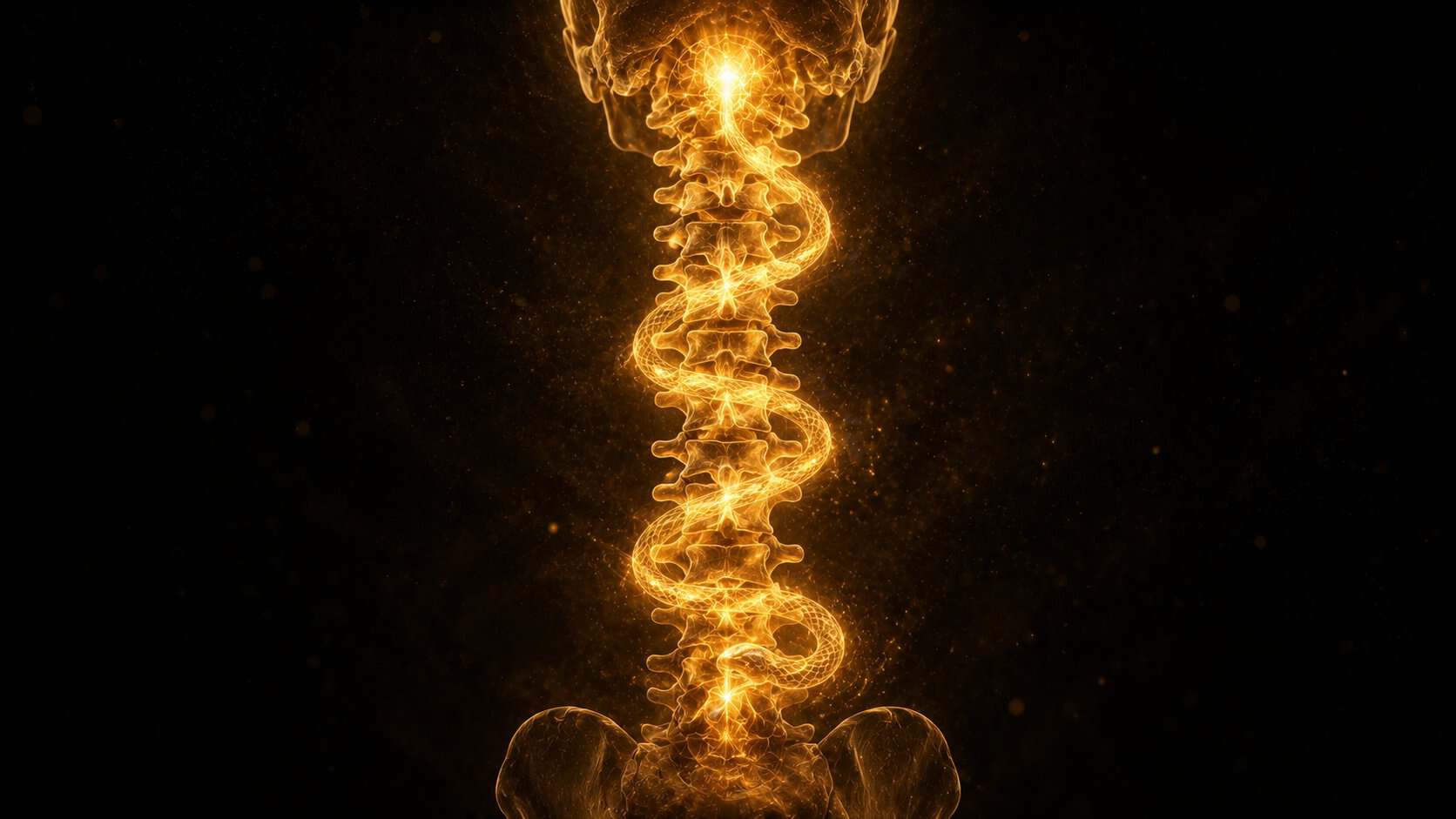
Kundalini
The serpent of inner fire described in every tradition that mapped the human energy system, the biblical brazen serpent, the Christos Oil that rises up the spine to the brain.
Kundalini is the Sanskrit word for the dormant biological energy traditionally pictured as a serpent coiled at the base of the spine. When activated, it rises up through the spinal column, through specific energy centers, and reaches the crown of the head where it triggers what every tradition that mapped this called awakening. The vocabulary is Hindu. The phenomenon is universal.
This page covers what kundalini actually is, the anatomical pathway, the biblical and Christian references most readers miss, the cross-cultural parallels, and the practical work of safe activation. The sacred secretion tradition this site is built around is the specific Christian-mystical version of the same teaching.
What Kundalini Actually Is
The Sanskrit word kundalini (कुण्डलिनी) literally means "coiled one." In Hindu yogic tradition, kundalini is described as a serpent of feminine creative energy coiled three and a half times at the base of the spine, in the muladhara chakra at the sacrum and perineum. The serpent is asleep. Yogic practice aims to wake it.
When the serpent wakes, it rises through the central energy channel of the body, called the sushumna nadi, which runs along the spinal column. As it rises, it passes through six chakras (energy centers) along the way: muladhara at the base, svadhisthana at the sacrum, manipura at the navel, anahata at the heart, vishuddha at the throat, ajna at the brow, and finally reaches sahasrara at the crown of the head. The crown chakra opening is what the tradition calls kundalini awakening.
The energy is described as both feminine (Shakti) and serpent-shaped because the spiraling motion up the spine alternates between two side channels (ida, lunar, left, feminine, and pingala, solar, right, masculine) wrapping around the central sushumna. The pattern is identical to the double helix of the caduceus (the staff of Hermes), the two serpents winding around the central staff. The caduceus is now the medical symbol for healing. The original meaning is the kundalini path.
What the tradition is describing in anatomical terms is the central nervous system, with the spinal column as the central channel and the autonomic nervous system (sympathetic and parasympathetic) as the two side channels. The chakras correspond to nerve plexuses and the major endocrine glands. Kundalini activation, in modern neurophysiological terms, is the awakening of latent capacity in the central nervous system through specific practices that shift its baseline state.
The Path Up the Spine
The kundalini path is anatomically specific. The traditions did not describe a vague spiritual feeling. They mapped a precise pathway that corresponds to known structures.
Specific sequencing and full protocol: Redacted, Chapter 21.
- Muladhara (root) at the perineum and sacrum. Corresponds to the sacral plexus and the reproductive system. The dormant kundalini energy is said to coil here in three and a half turns.
- Svadhisthana (sacral) just above muladhara at the sacral region. Corresponds to the hypogastric plexus, the gonads, and the lower spinal reflex centers.
- Manipura (solar plexus) at the navel. Corresponds to the solar plexus, the adrenals, and the digestive system. The fire center.
- Anahata (heart) at the heart center. Corresponds to the cardiac plexus, the thymus, and the heart's intrinsic nervous system, which has been measured to have approximately 40,000 neurons of its own.
- Vishuddha (throat) at the throat. Corresponds to the cervical plexus, the thyroid, and the cranial nerve junction at the brain stem.
- Ajna (brow) at the third eye position. Corresponds to the cavernous plexus, the pituitary, and indirectly to the pineal gland deeper in the brain.
- Sahasrara (crown) at the top of the head. Corresponds to the cerebral cortex and, in the Christos Oil reading, the pineal complex and the claustrum.
Cerebrospinal fluid (CSF) is the physical fluid that runs along this exact pathway. It is produced in the brain ventricles, flows down the central canal of the spinal cord to the sacrum, and back up. The flow has a tidal rhythm with the breath and the heart beat. The traditional descriptions of the inner fluid rising up the spine in spirit-driven awakening match closely with the actual circulation of cerebrospinal fluid through the central nervous system at specific physiological moments. Detailed treatment of this pathway on pineal gland activation.
Biblical Serpents and the Christos Oil
The kundalini teaching exists in the Christian tradition under a different vocabulary. Most readers miss the references because the imagery is read literally instead of anatomically. Once the inner reading is recognized, the parallels are obvious.
- Moses' brazen serpent. Numbers 21:8 to 9. Moses is instructed to make a bronze serpent and set it on a pole. Anyone bitten by serpents in the wilderness who looked at it would live. The serpent on the pole is the kundalini imagery exactly: a serpent raised up on the central column.
- Christ's reference to Moses' serpent. John 3:14: "As Moses lifted up the serpent in the wilderness, even so must the Son of man be lifted up." The crucifixion is mapped onto the serpent-on-the-pole. The serpent raised on the pole is the awakening of kundalini up the central column. The body is the pole. The Christos is the awakened serpent.
- The caduceus. The staff of Hermes, two serpents wound around a central staff with wings at the top. The original meaning was the awakened kundalini, with the two side channels (ida and pingala) wrapped around the central channel (sushumna). The wings at the top represent the activated crown. Modern medicine adopted this symbol because the kundalini awakening was understood as the deepest form of healing.
- The single eye. Matthew 6:22. When the inner integrated eye is open, the body becomes a vessel of light. The single eye is what activates when the kundalini reaches the crown. See the third eye for the deeper anatomical treatment.
- The anointing. The Greek chrio means "to anoint with oil." The Christ is the anointed one. The anointing happens in the head. The Christos Oil tradition treats the rising cerebrospinal fluid as the literal anointing oil, applied to the inner organs of the head at the moment the kundalini reaches the crown.
The connection is not speculative. The early Christian mystics, the Christian Kabbalists, and the alchemical traditions all carried versions of this teaching. It was buried in the institutional church but preserved in the contemplative side, in the Gnostic gospels, and in the alchemical and Hermetic texts that survived the Inquisition.
Every Tradition Had a Version
The serpent-up-the-spine imagery is so widespread that the most parsimonious explanation is that humans, paying close attention to inner energetic states, independently mapped the same phenomenon.
- Daoist internal alchemy describes a circulation of qi up the spine (the "Du" channel) and down the front of the body (the "Ren" channel) called the microcosmic orbit. Activation produces the same phenomena Hindu kundalini practitioners report.
- Ancient Egyptian iconography shows the uraeus serpent rising from the pharaoh's forehead. The same serpent in the same anatomical location as the activated kundalini in the Hindu system. The pharaoh wore his awakening as a crown.
- Sufi tradition describes lataif al-sitta, six subtle centers in the body that activate through specific contemplative practices. The locations map closely to the chakras.
- Mesoamerican cultures revered the feathered serpent (Quetzalcoatl, Kukulkan). The serpent-with-wings imagery is the same as the caduceus, the awakened serpent that has grown wings (reached the crown).
- The mystery schools of Pythagoras, the Eleusinian Mysteries, the Egyptian temple tradition, all carried versions of the same teaching. The initiation processes were designed to produce the awakening.
- Tibetan Buddhism describes tummo (inner heat), a specific practice that produces the rising of biological heat up the central channel. The phenomenology overlaps with kundalini reports. Modern measurements of tummo practitioners show measurable changes in core body temperature and brain activity.
The convergence is too consistent to be coincidence. Different cultures, different vocabularies, same anatomical structure, same activation methods, same phenomenology of the resulting experience. The traditions are describing one fact about the human nervous system from many angles.
Chapter 21. The Christos Oil.
The full kundalini path mapped through the Christian-mystical, Hindu yogic, Daoist alchemical, and ancient Egyptian traditions. The anatomy of cerebrospinal fluid. The lunar timing. The integrated practice. Cross-referenced through six traditions.
Sacred Secretion and the Monthly Cycle
The Christos Oil tradition adds something the generic kundalini teaching often lacks: specific timing. The traditional teaching is that the inner oil (the cerebrospinal fluid) reaches its peak rising point at a specific moment each lunar cycle, when the sun is in a particular zodiacal alignment. The timing is approximately monthly, lasting about two and a half days, and the precise window varies by birth chart and lunar phase.
During this window, certain practices have outsized effect. Fasting, meditation, sexual abstention, and specific postures are said to direct the rising oil to the brain rather than letting it dissipate. The traditions called the failure mode "spilling" and treated it as a missed opportunity in the monthly cycle of inner alchemy.
The sacred secretion calendar tracks the lunar window each month. Detailed treatment of the calendar and the practices that go with it on the sub-page. The point for this overview: the kundalini teaching, when integrated with the lunar timing the older traditions specified, becomes a monthly practice rather than a once-in-a-lifetime event.
The conservative reading. The lunar timing tradition is well-documented in multiple cultures (Hindu lunar calendars, Hebrew lunar months, ancient Egyptian timekeeping, Christian Easter calculation, Islamic Ramadan). The specific claim that human cerebrospinal fluid follows a lunar tidal rhythm is supported by some recent research on circumlunar biological rhythms but is not yet mainstream science. The traditional practice is internally consistent and has been refined over centuries by people who took it seriously.
Symptoms of an Active Awakening
A real kundalini awakening produces specific phenomena that the traditions described and modern practitioners consistently report. The phenomena are not signs of mental illness, but they can be confused with one. The traditions emphasized strongly that this work should be done slowly and with experienced guidance.
- Spontaneous physical movements. Involuntary swaying, postural shifts, sometimes specific yogic postures arising without intention. The traditions called these kriyas.
- Heat sensations. Bands of warmth or actual heat traveling up the spine. Sometimes intense enough to cause sweating. The Tibetan tummo tradition specifically cultivates this.
- Light phenomena. Internal visual experiences: points of light, geometric patterns, sustained inner illumination, sometimes the perception of being surrounded by light.
- Sound phenomena. Hearing inner sounds: a high-pitched tone, a humming, ringing, or in advanced cases what the tradition called the "unstruck sound" (anahata nada).
- Energy surges. Sudden waves of energy moving through the body, sometimes pleasant, sometimes overwhelming.
- Emotional intensification. Old emotional patterns surfacing for processing. Sometimes intense joy, sometimes intense grief, sometimes both in waves.
- Sleep changes. Either much less sleep needed, or much deeper sleep with vivid dreams. The pineal gland is implicated.
- Sensory acuity. Perception becoming sharper. Tastes more vivid, colors brighter, sounds more distinct.
The traditions also documented a failure mode they called "kundalini syndrome": an activation that was too sudden, with insufficient preparation, producing chronic symptoms that resemble anxiety disorders, sleep disorders, and dysautonomia. This is why the traditions emphasized slow, supervised, conservative practice over forceful methods. The fastest way is not the safest way.
How to Safely Activate
The traditions converged on a set of practices that produce activation slowly and stably. The convergence itself is the evidence. Different cultures, working independently, arrived at similar protocols.
- Sustained meditation. The foundation. Daily concentration practice for years. The traditions are consistent: there is no shortcut around this.
- Pranayama (breath work). Specific breathing techniques, especially alternate nostril breathing (nadi shodhana), which directly balances the ida and pingala channels.
- Asana (posture). Specific postures that support the energy channels: spine straight, head balanced, sustained sitting without strain.
- Fasting. Periodic fasting clears obstacles in the system. The biblical fasting patterns the traditions used are the proven approach.
- Sexual abstention during the lunar window. The sacred secretion tradition specifically. The energy directed downward as reproductive seed is the energy that, retained, rises up the spine.
- Decalcification of the pineal gland. The destination point of the rising kundalini. A calcified pineal cannot receive the inner anointing properly. Detailed protocol on how to decalcify the pineal gland.
- Devotion. Sustained orientation toward something larger than the small self. The bhakti path. The fastest accelerator the traditions know of.
- Experienced guidance. Not optional. The traditions are unanimous on this. A teacher who has walked the path can help navigate the experiences as they arise. Self-directed forced activation is the path most associated with kundalini syndrome.
The forceful methods (intensive breath retention, extreme postures, certain drug-assisted protocols) can produce dramatic activation but at significant risk. The traditions had reasons for emphasizing the slow path. The fastest activation, statistically, is the most likely to produce long-term destabilization.
The full protocol, the specific sequencing, and the why behind each step are covered in the book: Redacted, Chapter 21.
Master Thyself, Chapter 21Read The Christos Oil →Frequently Asked Questions
What is kundalini?
Kundalini is the Sanskrit name for a latent biological-energetic capacity described as a serpent coiled at the base of the spine, which, when activated through specific contemplative practices, rises through the central energy channel of the body and produces the awakening experience the traditions call enlightenment, samadhi, or union.
Is kundalini real or imaginary?
The phenomenology is real. Consistent reports from practitioners across cultures and centuries describe the same physical sensations, emotional patterns, and perceptual shifts. Whether the underlying mechanism is best described in traditional energy terms or in modern neurophysiological terms is a vocabulary question. The experiences themselves are well-documented and reproducible.
How long does it take to awaken kundalini?
The traditions estimated the work in decades, not years. Spontaneous partial activations can happen quickly, sometimes within months of intense practice, but stable integrated awakening is a long path. Anyone promising fast results is selling something the traditions did not recognize.
Can kundalini be dangerous?
Yes. Forced activation with insufficient preparation can produce a syndrome that resembles anxiety disorders, panic attacks, dysautonomia, and in severe cases requires medical intervention. This is why the traditions emphasized slow, supervised, conservative practice. The risk is not in the awakening itself but in the rate of the awakening relative to the practitioner's preparation.
Is kundalini in the Bible?
Yes, under different vocabulary. Moses' brazen serpent on the pole (Numbers 21), Christ's reference to it in John 3:14, the "single eye" of Matthew 6:22, the anointing of the Christos, and the alchemical and mystical Christian tradition all carry versions of the kundalini teaching. The institutional church largely lost the inner reading. The contemplative tradition kept it alive.
What is the relationship between kundalini and the pineal gland?
The kundalini rises up the central channel and reaches its destination at the crown of the head, where the pineal gland sits. The pineal is the anatomical endpoint of the kundalini path. Its functional state determines whether the rising energy can complete its circuit. Decalcification of the pineal is a prerequisite for stable awakening.
Chapter 21. The Christos Oil.
The full kundalini pathway mapped through Hindu yogic, Christian mystical, Daoist alchemical, ancient Egyptian, and Sufi traditions. The anatomy. The lunar timing. The practical work. Cross-referenced through six traditions.
Get Your Copy on Amazon