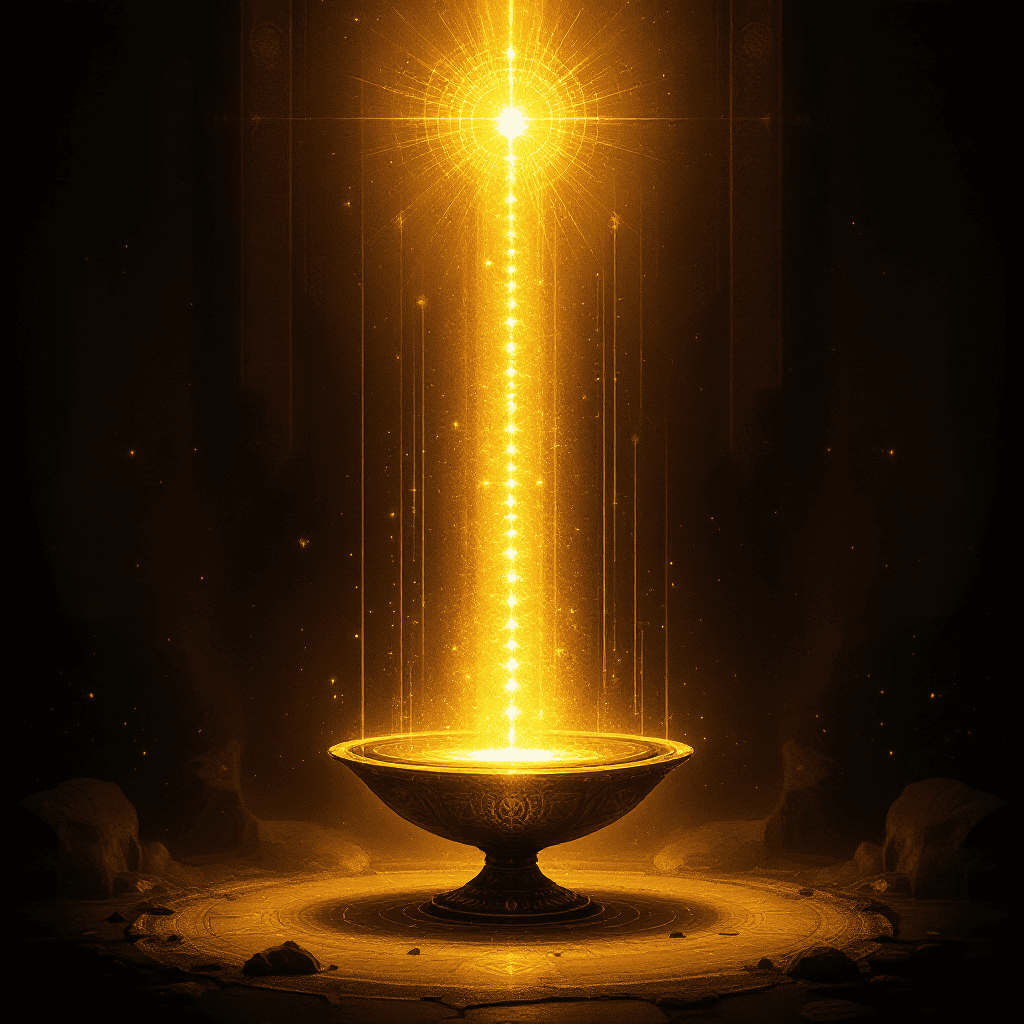
The oil in the lamp parable meaning has been preached as a lesson in spiritual readiness for centuries, but what if the oil Jesus described was not metaphorical at all? What if the ten virgins, five wise and five foolish, were carrying a teaching about an actual biological substance produced within the human body, a sacred secretion that must be preserved, cultivated, and raised at the precise moment to illuminate the inner temple?
Most readers know the parable from Matthew 25. Ten virgins await the bridegroom. Five bring extra oil for their lamps. Five do not. When the bridegroom arrives at midnight, the foolish virgins find their lamps flickering out. They rush to buy more oil, but by the time they return, the door is shut. The wise virgins enter the wedding feast. The foolish are left outside.
On the surface, it reads as a warning about preparedness. But every detail in the story, the oil, the lamps, the midnight hour, the wedding, the shut door, points to something far more precise. This parable is not about candles or moral virtue. It is an encoded manual for the Christos Path, the inner journey of the sacred secretion rising through the body to awaken divine perception.
What the Church Taught and What It Hid
For two thousand years, Christian teaching has interpreted the oil as faith, good works, or spiritual devotion. The foolish virgins represent those unprepared for Christ’s return. The wise represent the faithful remnant. The door that shuts is judgment day. These interpretations are not wrong, but they are incomplete. They preserve the outer shell while the inner teaching remains hidden.
Early Christianity, before it became institutionalized, carried a mystical core. Gnostic traditions taught that resurrection was not only a future event but a present transformation, an awakening of the divine spark within the body. What threatened the institution was not heresy but sovereignty: the idea that a human being could access the divine directly, without priest or intermediary. The oil in the lamp parable meaning was one of the keys to that access, and it was deliberately obscured.
To recover what was hidden, we must look at the parable through the lens of sacred anatomy. The lamp is not a clay vessel filled with olive oil. The lamp is the human body. The oil is the cerebrospinal fluid carrying hormonal secretions from the brain down the spine and, when preserved through discipline, back up again to illuminate the pineal gland, the single eye that fills the whole body with light.
The Lamp: Your Body as the Living Temple
Scripture repeatedly identifies the body as a temple. Paul wrote plainly: “Know ye not that ye are the temple of God, and that the Spirit of God dwelleth in you?” (1 Corinthians 3:16). If the body is the temple, then the lamp is not external. It is the biological architecture within.
In ancient oil lamps, the wick draws fuel upward from the reservoir. The flame burns at the top, where wick meets air. The human body mirrors this design exactly. The sacred oil, produced in the claustrum deep within the brain, descends through the cerebrospinal fluid along the spinal column. If preserved through fasting, sexual restraint, and emotional discipline, it ascends back up the 33 vertebrae to reach the pineal gland, where it ignites inner vision. The lamp of the body is the eye, Jesus said. If your eye is single, your whole body will be full of light (Matthew 6:22).
This is not poetry. It is physiology. The pineal gland, seated at the geometric center of the brain, responds to light and darkness, governs circadian rhythm, and has been associated across traditions with spiritual perception. When the Christos oil reaches this gland after its journey up the spine, perception shifts. The veil lifts. What was hidden becomes visible. The lamp is lit.
The Oil: The Sacred Secretion
The oil in the parable is the sacred secretion itself, a biological fluid refined within the body’s inner chambers. Modern science knows it as cerebrospinal fluid, but that clinical term does not capture its full function. This fluid bathes the brain and spinal cord, carries neuropeptides and hormones, and pulses with every breath. It is the river of life flowing through the temple, the Jordan through which the seed must be baptized.
Ancient mystery schools across Egypt, India, Greece, and the Hebrew mystical tradition all preserved teachings about this inner oil. The Egyptians called it the Djed pillar rising. The yogis called it kundalini. The Hebrews encoded it in the anointing rituals of kings and priests. The oil poured on the head in ceremony was a symbol of the oil that rises within when the vessel is pure. To be anointed, to be Christed, was never about a title bestowed from outside. It was about the sacred secretion awakened from within.
This secretion begins its journey in the claustrum, a hidden chamber in the brain that neuroscience now suspects may be the seat of consciousness itself. From there it descends into the solar plexus, the house of bread, where the seed is born. If the vessel is kept pure, no scattered desire, no indulgence in appetite, no chronic stress fracturing the current, the oil is preserved. It gathers strength. And when the lunar timing aligns, the biological mechanism of the Christos oil completes its cycle, rising back through the spine to crown the seeker with light.
The Five Wise and the Five Foolish
Ten virgins. Five wise, five foolish. The number is not random. Ten is completion: ten commandments, ten sefirot on the Tree of Life, ten fingers through which energy flows. The split into five and five mirrors the division between those who preserve the oil and those who squander it.
The wise virgins brought extra oil. They prepared in advance. They knew the bridegroom’s arrival could not be forced, only anticipated. The oil in the lamp parable meaning here is clear: discipline precedes illumination. The secretion cannot rise through a vessel poisoned by indulgence. Fasting, breathwork, sexual transmutation, emotional coherence, these are not moral suggestions. They are biological requirements. The ancients knew what modern neuroscience is only beginning to confirm: the body’s chemistry responds to discipline, and the glands that govern perception, the pineal and pituitary, function optimally only when the system below them is pure.
The foolish virgins carried no extra oil. When their lamps began to dim, they asked the wise to share. But the wise refused. “Not so; lest there be not enough for us and you: but go ye rather to them that sell, and buy for yourselves.” This refusal has troubled readers for centuries. Why would the wise be so selfish? Because the oil cannot be shared. It is not a commodity. It is a state of being, cultivated within each individual vessel. No one can do the inner work for another. No institution can grant it. No ritual can substitute for the discipline required to raise it.
When the foolish virgins returned, the door was shut. “I know you not,” the bridegroom said. The door is the gate of the inner temple, and it opens only when the oil has been raised. To arrive without oil is to arrive without the inner preparation that makes entry possible. The exclusion is not punishment. It is function. A lamp without oil cannot burn. A body without the sacred secretion cannot illuminate.
The Bridegroom at Midnight
The bridegroom arrives at midnight. Not dawn. Not noon. Midnight. This detail encodes the lunar timing central to the Christos Path. The sacred secretion operates on a monthly cycle, tied to the moon’s rhythm just as the body’s own cycles follow lunar phases. For men, the new moon marks the optimal window. For women, the follicular phase following menstruation aligns with the body’s natural renewal. Midnight is the darkest hour, the still point between one day and the next, the moment when the pineal gland, freed from light interference, produces its deepest secretions.
The bridegroom is not an external figure. The bridegroom is the divine spark, the higher self, the Christos consciousness that enters the vessel when the oil has been raised and the temple made ready. The wedding is the sacred union of masculine and feminine within, the pituitary and pineal glands coming into coherence, producing the milk and honey that scripture describes as the promised land. This union cannot be forced. It cannot be faked. It arrives only when every condition has been met: the oil preserved, the vessel purified, the timing aligned.
Why the Parable Was Encoded
If the oil in the lamp parable meaning is this precise, why was it not taught openly? Because knowledge is power, and awakening threatens control. A population that understands the inner oil, the biological resurrection, the direct access to divine perception encoded in their own bodies, does not need priests to mediate, kings to rule, or institutions to grant permission. The entire architecture of hierarchical religion collapses when the individual remembers they are the temple.
This is why Gnostic texts were burned, mystery schools driven underground, and the mystical core of Christianity replaced with doctrine and obedience. The outer teaching, be prepared, have faith, wait for Christ’s return, keeps seekers dependent. The inner teaching, preserve the oil, purify the vessel, raise the secretion, walk the path yourself, makes seekers sovereign. One builds an empire. The other dismantles it.
Jesus did not come to build an institution. He came to demonstrate a process. “I am the way, the truth, and the life,” he said. Not “worship me.” Not “wait for me to return.” Walk the way. Embody the truth. Live the life. The oil in the lamp is the fuel for that journey, and the parable was a map disguised as a morality tale, passed down through generations so the teaching could survive even when the institution tried to bury it.
The Path Forward: Preserving Your Own Oil
Understanding the parable is the first step. Walking it is the work. The oil cannot be raised through belief alone. It requires embodied discipline: fasting to quiet the lower drives, breathwork to regulate the nervous system, sexual restraint during the lunar window to preserve the generative force, and emotional coherence to keep the heart’s field stable. These practices are not religious ornaments. They are the biological levers that activate the inner temple.
The wise virgins in the parable did not wait passively. They prepared actively. They brought extra oil because they understood the journey required more than a single effort. Awakening is not a one-time event. It is a rhythm, a monthly discipline, a spiralic ascent through the body’s own sacred architecture. Each cycle refines the vessel. Each fast clears the channel. Each breath moves the current. Over time, the lamp grows brighter. The door opens. The bridegroom arrives.
For those ready to understand how this process unfolds in full anatomical and spiritual detail, Master Thyself by Alex Wolfram provides the complete framework, mapping every stage from conception in the claustrum to resurrection at the crown. The book does not replace the inner work, but it offers the blueprint that centuries of suppression tried to erase.
What the Oil Actually Does
When the sacred secretion is preserved and raised, its effects are not abstract. Practitioners across traditions report measurable shifts: heightened clarity, emotional stability, physical vitality, spontaneous insight, and a perceptual opening often described as the veil lifting. These are not mystical rewards granted by an external deity. They are the natural result of a biological system functioning as designed.
The pineal gland, when bathed in the refined secretion, releases compounds that shift consciousness. Some researchers have proposed it produces endogenous DMT, though this remains scientifically unconfirmed in humans. What is confirmed: the pineal contains photoreceptive cells similar to the retina, responds to electromagnetic signals, and governs the body’s circadian and seasonal rhythms. It is, by every measure, the lamp of the body. When the oil reaches it, the single eye opens. Perception expands. The inner and outer worlds no longer appear separate.
This is why the parable ends with a feast. The wedding feast is not a literal banquet. It is the overflow of vitality, joy, and coherence that floods the system when the inner marriage is complete. The body becomes the promised land: flowing with milk from the pituitary and honey from the pineal, the balance of masculine and feminine energies restored, the temple illuminated from within.
The Timing You Cannot Force
One of the hardest lessons in the parable is that the bridegroom’s arrival cannot be controlled. The wise virgins prepared, but they did not dictate the hour. This reflects the body’s own rhythm. The sacred secretion operates on a monthly cycle. You can prepare the vessel through fasting and discipline. You can align your practice with the lunar window. But you cannot force the ignition. The pineal activates when every condition is met, not before.
This is where impatience derails most seekers. They fast for a day, meditate for a week, expect immediate results, and when nothing dramatic occurs, they conclude the teaching is false. But the oil does not rise in a weekend workshop. It rises when the vessel has been refined over cycles, when the lower drives have been mastered, when the heart is coherent and the mind is still. The wise virgins waited. They did not demand. They trusted the process and kept their lamps ready.
The path requires humility. You are not in control of the timing. You are only responsible for the preparation. Fast during the correct window. Preserve the generative energy. Breathe deeply. Keep your thoughts aligned with truth and your heart open to love. When the conditions are met, the bridegroom will come. Not because you deserve it, but because the design of your body makes it inevitable.
The Door That Shuts
“And the door was shut.” This is the most sobering line in the parable. It suggests there is a point of no return, a moment when the opportunity passes and cannot be recovered. In the context of the sacred secretion, this is true. The lunar window opens once per cycle. If the oil is squandered through indulgence, scattered through distraction, or never cultivated at all, the door closes. The next cycle begins, but the vessel must be prepared again from the beginning.
This is not damnation. It is design. The body’s chemistry operates on rhythms that cannot be overridden by willpower or wishful thinking. The pineal responds to melatonin surges tied to darkness and lunar phase. The pituitary releases growth hormone and oxytocin during deep rest and fasting states. These are not mystical phenomena. They are endocrine functions, measurable and predictable, but only accessible when the conditions are right.
The foolish virgins arrived too late not because they were morally inferior but because they did not understand the mechanism. They treated the oil as something that could be purchased at the last minute, a commodity rather than a cultivated state. The shut door is not God’s rejection. It is biology’s boundary. Coherence cannot be faked. Awakening cannot be rushed. The lamp must be filled before the bridegroom arrives, or it will not burn.
Redacted Protocol and the Full Path
The precise timing of the fast, the specific duration required to trigger autophagy and endocrine reset, the exact alignment of breath and posture that moves the cerebrospinal fluid up the spinal column, and the detailed method for stabilizing heart coherence during the critical window are REDACTED, READ CHAPTER 21. The parable gives the framework. The book gives the map.
The relationship between the lunar phase and the body’s hormonal cascade, the mechanism by which the claustrum signals the pineal to begin the descent, and the reason sexual energy must be transmuted rather than released during the 40-hour preparation window are REDACTED, READ CHAPTER 21. Jesus encoded the process in a story. Alex Wolfram decoded it into a protocol.
The seven gates the oil must pass through on its ascent, the specific mantras or tones that open each gate, the role of the vagus nerve in amplifying the secretion at the optic chiasm, and why the oil rests in the thalamus for three days before rising to the crown are REDACTED, READ CHAPTER 21. Chapter 21 of Master Thyself walks the full Christos Path, station by station, gate by gate.
The dietary restrictions that preserve the oil’s potency, the specific foods that block its ascent, the reason fluoride calcifies the pineal and prevents illumination, and the detoxification sequence required to reverse decades of contamination are REDACTED, READ CHAPTER 15. You cannot raise the oil through a poisoned temple.
The exact breathwork pattern that moves cerebrospinal fluid from the sacrum to the crown, the count and rhythm that opens the spinal gates, and the reason most pranayama techniques fail to complete the circuit are REDACTED, READ CHAPTER 21. Breath is not passive. It is the lever.
The connection between the oil and DNA activation, why only coherence allows dormant genetic sequences to express, and what percentage of the genome remains locked until the pineal is illuminated are REDACTED, READ CHAPTER 21. The oil is not the end. It is the key.
The reason the parable specifies virgins, the connection between sexual purity and electromagnetic field coherence, and how a single release during the critical window resets the entire cycle are REDACTED, READ CHAPTER 21. Restraint is not repression. It is redirection.
The full synthesis of how the parable maps onto the Tree of Life, which of the ten sefirot correspond to each stage of the oil’s journey, and why Da’at, the hidden gate, can only open when the secretion reaches the optic chiasm are REDACTED, READ CHAPTER 20. The parable is one thread. The Tree is the loom.
The historical suppression of this teaching, which councils decided to externalize the anointing, why the sacred secretion was replaced with ritual chrism oil, and how early Christian mystics preserved the inner path in hidden texts are REDACTED, READ CHAPTER 11. The institution did not lose the teaching. It buried it.
The connection between the oil and the 144,000 sealed in Revelation, why that number encodes the harmonic frequency of crown activation, and how the forehead sealing corresponds to pineal ignition are REDACTED, READ CHAPTER 21. The seal is not a mark. It is a state.
The reason five virgins succeeded and five failed, what the number five encodes in sacred numerology, and how the split reflects the division between those who master the lower chakras and those who remain trapped in base appetite are REDACTED, READ CHAPTER 13. Numbers are not decoration. They are coordinates.
The relationship between this parable and the feeding of the 5,000, why both involve distribution of substance that cannot be shared externally, and how both encode the same mystery of inner multiplication are REDACTED, READ CHAPTER 21. Every miracle is a map.
Your Lamp Is Already Within You
The oil in the lamp parable meaning is not a distant theological puzzle. It is a present biological instruction. You are the lamp. The oil is produced within you every month. The bridegroom is not coming from the sky. He is already seated in the hidden chamber of your own brain, waiting for the vessel to be prepared. The wedding feast is not in heaven. It is the overflow of vitality and coherence when your inner temple is finally illuminated.
The wise virgins understood this. They did not wait for someone else to fill their lamps. They did the work: fasting, discipline, alignment with natural rhythms. They brought extra oil because they knew the journey required more than one attempt. They prepared in advance because they respected the timing they could not control. And when the bridegroom arrived, they were ready. The door opened. They entered. The feast began.
That same door stands before you. Not in the future. Now. The question is not whether you are chosen. The question is whether you are prepared. Have you preserved the oil? Have you purified the vessel? Have you aligned your life with the rhythms your body was designed to follow? Or are you still waiting for someone else to do the work, hoping the oil can be purchased at the last minute, believing the door will stay open forever?
It will not. The bridegroom comes at midnight. The wise are ready. The foolish are left outside. This is not cruelty. This is design. The lamp must be filled. The oil must be raised. The path must be walked. No one can do it for you. But the teaching has been preserved, encoded in parables, hidden in plain sight, waiting for those with eyes to see and ears to hear. The oil is within you. The lamp is your body. The door is open. For now.