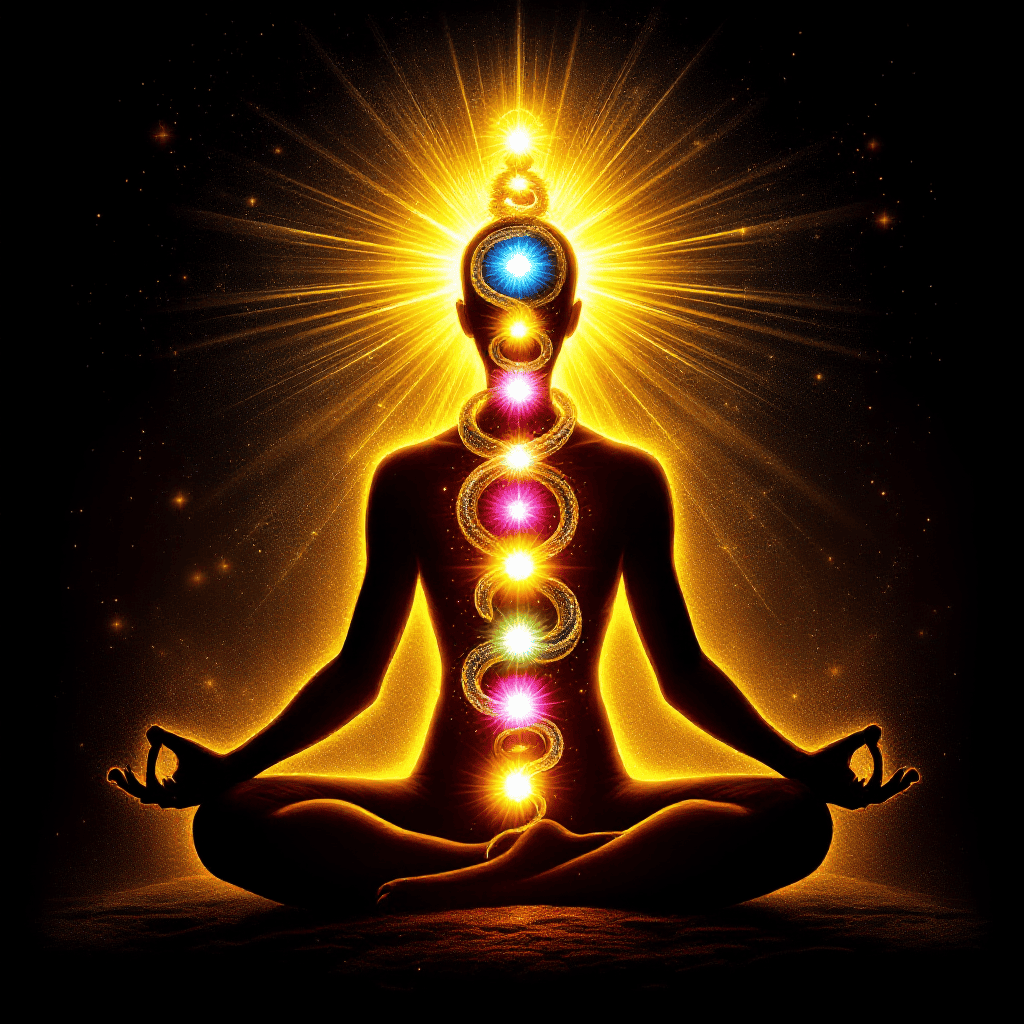
Kundalini rising explained begins with understanding the body as a vertical axis of consciousness, a living ladder through which dormant energy ascends from the base of the spine to the crown of the head. This is not metaphor. It is a biological and spiritual process encoded in every human body, preserved across traditions for millennia, and waiting to be activated through discipline, breath, and alignment. When kundalini rises, it moves through 7 primary energy centers called chakras (wheels of energy that govern physical, emotional, and spiritual function), purifying distortion and illuminating awareness at each stage until the vessel becomes a clear channel for divine light.
The journey from root to crown is the curriculum of human transformation. The ancients who mapped it knew the body as temple, the spine as ladder, and kundalini as the sacred fire that turns survival consciousness into spiritual sovereignty. What they preserved in symbol and ritual, modern physiology now confirms in the architecture of the nervous system, the endocrine glands, and the cerebrospinal fluid that bathes the spinal column. Understanding kundalini rising explained means seeing the body not as static matter but as a dynamic system designed for awakening.
The Serpent Fire: What Kundalini Actually Is
The word kundalini comes from Sanskrit, meaning “coiled one.” It describes dormant spiritual energy that lies curled at the base of the spine, often visualized as a serpent sleeping in the root chakra. This serpent is not a metaphor borrowed from mythology. It represents a real energetic current that, when awakened, spirals upward through the central channel of the spine known as sushumna. The serpent imagery appears across cultures because the mechanism it points to is universal: a rising force that transforms consciousness as it ascends.
Kundalini is the primal life force, the spark of creation individualized within each human being. In its dormant state, this energy fuels basic survival: reproduction, appetite, fight or flight. When redirected upward through breathwork, meditation, fasting, and the cultivation of virtue, kundalini becomes the current of resurrection. It is the oil rising through the body’s inner temple, the same process described in Christian mysticism as the sacred secretion and in Taoist alchemy as the elixir of immortality. Different names, one design.
Physiologically, kundalini rising corresponds to the activation of the parasympathetic nervous system, the harmonization of the endocrine glands along the spine, and the optimization of cerebrospinal fluid flow. The autonomic nervous system governs involuntary processes like heart rate, digestion, and stress response, and kundalini practices directly influence this system by calming the fight-or-flight reflex and activating rest-and-repair states. When the body enters deep coherence, energy that once scattered into craving and fear begins to move vertically, purifying the vessel and igniting centers of higher perception.
The Spinal Ladder: 33 Vertebrae, 7 Gates
The human spine contains 33 vertebrae, forming the biological ladder through which kundalini must climb. This is why sacred traditions across the world encoded the number 33: it is written into the body itself. Freemasonry’s 33 degrees, Christ’s age at crucifixion, the Rig Veda’s 33 principal deities, all point to the same vertical ascent through the spinal column, one rung at a time.
Along this ladder sit 7 primary chakras, energy centers that correspond to specific endocrine glands and govern distinct domains of consciousness. From root to crown, they are:
- Root (Muladhara): Base of the spine, adrenal glands. Governs survival, safety, and grounding.
- Sacral (Svadhisthana): Below the navel, gonads. Governs creativity, sexuality, and emotional flow.
- Solar Plexus (Manipura): Above the navel, pancreas. Governs personal power, will, and identity.
- Heart (Anahata): Center of the chest, thymus. Governs love, compassion, and coherence.
- Throat (Vishuddha): Throat, thyroid. Governs communication, truth, and expression.
- Third Eye (Ajna): Between the eyebrows, pineal and pituitary glands. Governs intuition, vision, and inner knowing.
- Crown (Sahasrara): Top of the head. Governs spiritual connection, enlightenment, and unity with Source.
Each chakra is a gate that must be purified before kundalini can rise cleanly to the next level. Blockages caused by trauma, fear, unresolved emotion, or indulgence trap the current at lower centers, keeping consciousness locked in survival mode. When these blockages are cleared through discipline and inner work, the energy moves upward naturally, activating higher faculties of perception, compassion, and divine remembrance.
The Twin Currents: Ida and Pingala
Kundalini does not rise in isolation. It moves through the central channel, sushumna, flanked by two subsidiary currents that spiral around it. These are Ida and Pingala, the lunar and solar channels, representing feminine and masculine polarities within the energetic body. Ida is cool, receptive, and introspective, associated with the right hemisphere of the brain and the parasympathetic nervous system. Pingala is warm, active, and expressive, associated with the left hemisphere and the sympathetic nervous system.
The interweaving of Ida and Pingala around the central channel forms the same pattern encoded in the caduceus, the ancient symbol of healing carried by Hermes and adopted by modern medicine. The caduceus shows two serpents spiraling around a central staff, crossing at intervals that correspond precisely to the chakras. This is not coincidence. The staff is the spine. The serpents are the twin currents. The crossing points are the energy centers where polarity reconciles and kundalini advances.
When Ida and Pingala are balanced, the central channel opens and kundalini rises without resistance. When one dominates the other, the system destabilizes: too much solar energy burns the vessel with agitation and overactivity, while too much lunar energy collapses it into lethargy and dissociation. The path of kundalini rising explained requires the integration of opposites at every stage, not the dominance of one pole over the other.
Signs and Stages of Kundalini Activation
When kundalini begins to stir, the body and mind respond with measurable changes. These signs vary in intensity depending on the readiness of the vessel, the clarity of the channels, and the presence or absence of blockages. Some experience kundalini rising as a gentle warmth moving up the spine. Others report dramatic shifts in perception, spontaneous movement, or overwhelming emotional release. Both belong to the same process.
Common signs include:
- Heat or tingling along the spine, particularly at the base or crown
- Spontaneous breath shifts, including automatic retention or rapid breathing
- Involuntary body movements, trembling, or postural adjustments
- Waves of energy moving upward through the torso and head
- Inner light or geometric patterns seen behind closed eyes
- Pressure or pulsing at the third eye or crown
- Emotional purging: sudden grief, joy, or release of long-buried trauma
- Heightened sensitivity to sound, light, and energy fields
- Deep states of bliss, peace, or unity consciousness
- Clarity of thought, expanded perception, or direct inner knowing
These are not side effects. They are the natural responses of a system undergoing purification and upgrade. The key is not to force the process but to create the conditions that allow it to unfold safely. The sacred secretion framework provides the biological and spiritual context for understanding how the body’s inner anointing current rises when discipline, breath, and lunar timing align.
The Role of Breath and Pranayama
Breath is the primary tool for moving kundalini energy. In yogic tradition, pranayama (breath control practices that regulate life force) techniques are designed to awaken, direct, and stabilize the rising current. The breath does not merely oxygenate the blood. It regulates the autonomic nervous system, shifts brainwave states, influences cerebrospinal fluid pressure, and directly affects the glands that govern consciousness.
Specific practices include:
- Alternate Nostril Breathing (Nadi Shodhana): Balances Ida and Pingala, clearing the pathways for kundalini to rise through the central channel without obstruction.
- Breath of Fire (Kapalabhati): Rapid, rhythmic exhalations that generate heat at the solar plexus and stimulate the awakening of dormant energy at the root.
- Breath Retention (Kumbhaka): Holding the breath after inhalation or exhalation creates pressure shifts in the cerebrospinal fluid, activating the pineal gland and opening the third eye.
- Deep Diaphragmatic Breathing: Engages the vagus nerve, the longest cranial nerve connecting brain to gut, calming the nervous system and allowing energy to move without triggering fight-or-flight responses.
The mechanism is precise. Controlled breath slows the heart rate, lowers cortisol, and shifts the brain from beta waves (waking, analytical) into alpha and theta states (calm, receptive, visionary). In these states, the gates of perception soften, the pineal gland activates, and the inner current flows upward naturally. Breath is not preparation for kundalini rising. Breath is the activation key itself.
Purification Before Ascent: Why the Vessel Must Be Clean
Every tradition that preserved kundalini wisdom insisted on purification before activation. This was not moral posturing. It was biological necessity. Kundalini rising through an impure vessel amplifies whatever is already present. If the body is clogged with toxins, the mind scattered by craving, and the heart hardened by unresolved trauma, the rising current will destabilize rather than illuminate.
Purification operates on multiple levels:
- Physical: Fasting, clean water, whole foods, avoidance of seed oils, fluoride, processed sugars, and endocrine disruptors. The body is the temple. Poison the temple and the current cannot rise cleanly.
- Energetic: Clearing blockages through yoga, breathwork, sound healing, and somatic release. Trauma lodges in the tissues. Movement and vibration dislodge it.
- Emotional: Forgiveness, grief work, shadow integration. Kundalini will not bypass unresolved pain. It will surface it. Better to face it consciously than to have it erupt mid-ascent.
- Mental: Meditation, stillness, withdrawal from digital overstimulation. The mind must quiet before higher perception can open. Noise drowns the signal.
- Behavioral: Restraint of appetite, sexual discipline, truthful speech, service without ego. These are not arbitrary virtues. They are the conditions under which the lower centers release their hold and the current moves upward.
The full mechanism of how REDACTED, READ CHAPTER 21, including the biological timing windows, the glandular secretions involved, and the specific purification protocols that open each gate, is mapped in the complete framework in Master Thyself. What can be said here is that kundalini will not rise through distortion. The vessel must be prepared, or the fire will scatter rather than ascend.
The Dangers of Premature Activation
Kundalini rising explained includes acknowledging what happens when the process begins without adequate preparation. Premature activation, whether triggered by psychedelics, extreme breathwork, intense trauma, or spontaneous energetic events, can destabilize the nervous system and fragment perception rather than clarify it. This is not because kundalini itself is dangerous. It is because the vessel was not ready to hold the current.
Symptoms of kundalini crisis include:
- Chronic insomnia or disrupted sleep cycles
- Overwhelming energy surges that cannot be grounded
- Emotional flooding: uncontrollable crying, rage, or terror
- Dissociation or loss of sense of self
- Physical pain, particularly in the spine, head, or heart
- Hypersensitivity to sound, light, and other people’s energy fields
- Confusion, disorientation, or inability to function in daily life
These are not spiritual failures. They are the body’s signal that the current is moving faster than the system can integrate. The solution is not suppression but stabilization: grounding practices, somatic therapy, slowing the breath, reducing stimulation, and often working with a guide who understands the physiology of awakening. Kundalini is medicine, but like any medicine, dosage and timing matter.
The Crown Opens: Union with Source
When kundalini completes its ascent and reaches the crown chakra, the system undergoes transfiguration. The pineal and pituitary glands, seated in the brain’s inner chamber, unite in what yogic traditions call the sacred marriage. The pineal, associated with inner vision and the reception of light, produces secretions often described as golden or honey-like. The pituitary, the master regulator of the endocrine system, produces milky secretions of growth and nurture. Together they form the anointing oil, the nectar of immortality, the biological baptism that floods the body with regenerative chemistry.
This is not symbolic language. The pineal gland contains photoreceptive cells and piezoelectric calcite crystals that generate light under the right conditions. The pituitary governs every hormonal cycle in the body. When these two glands synchronize, the inner eye opens, perception shifts from fragmented to unified, and the individual consciousness recognizes itself as one with the divine current flowing through all creation.
The halo depicted above the heads of saints, Buddhas, and awakened beings across every tradition is the visible sign of this completion. It is coherence made radiant. It is the crown chakra fully activated, the light of the body shining outward as biophotons, the subtle electromagnetic field stabilized into a pattern that others can perceive. Kundalini rising explained culminates here: in the moment when the vessel becomes so clear that it no longer obstructs the light, and the inner fire that began as a coiled serpent at the base of the spine emerges as the lamp of the body, illuminating everything it touches.
Kundalini Across Traditions
The process of kundalini rising is not unique to Hindu or yogic systems. It appears in every culture that preserved the knowledge of the inner temple. In ancient Egypt, the Djed pillar represented the spine, and its ritual raising symbolized the resurrection of Osiris, the awakening of divine consciousness within the human form. The serpent rising from the pharaoh’s third eye, the uraeus, marked the activation of inner sight. In Kabbalah, the middle pillar of the Tree of Life maps the same vertical ascent, with Da’at as the hidden gate where wisdom and understanding fuse into gnosis. In Christian mysticism, the sacred secretion rises through the spinal column to anoint the pineal gland, fulfilling the prophecy that “the kingdom of God is within you.”
Taoism calls it the microcosmic orbit, the circulation of chi through the central channel and back down the front of the body in a continuous loop. Sufism describes fana, the annihilation of the ego, as the fire that burns away illusion so the soul can merge with the Beloved. Indigenous shamanic traditions speak of the World Tree, the axis mundi connecting earth and sky, which the shaman climbs in vision to retrieve knowledge from the upper realms. The mechanism is identical. The language changes by culture, but the body remains the same.
For those seeking to understand how cerebrospinal fluid and the sacred anointing process work in conjunction with kundalini activation, the biological pathways are inseparable. The oil that rises through the spine is both energetic and chemical, both spiritual and material. This is why the ancients never separated body from spirit. They knew the two were one system, and kundalini was the current that unified them.
Preparation and Practice: How to Begin
For those who wish to awaken kundalini safely, the path begins not with force but with discipline. The body must be purified, the mind quieted, and the heart opened before the current can rise without destabilizing the vessel. This is not a weekend workshop. It is a lifetime curriculum, and those who approach it with humility and patience are the ones who traverse it successfully.
Foundational practices include:
- Daily meditation: Even 10 minutes of stillness each morning begins to quiet the mind and stabilize the nervous system.
- Pranayama: Start with simple breath awareness, then progress to alternate nostril breathing and gentle retention.
- Asana (yoga postures): Physical movement clears blockages, strengthens the spine, and prepares the body to hold higher frequencies.
- Fasting: Periodic fasting, whether intermittent or extended, triggers autophagy and endocrine reset, creating the internal conditions for kundalini to stir.
- Mantra and sound: Chanting activates the vagus nerve and attunes the nervous system to specific frequencies that support energetic ascent.
- Ethical alignment: Truthfulness, non-harm, restraint of craving, and service without ego. These are not optional. They are the conditions under which the gates open.
The specific timing windows aligned with REDACTED, READ CHAPTER 21, the lunar cycles that govern the body’s internal rhythms, and the exact protocols for preserving and raising the sacred secretion are detailed in the full text. What matters here is understanding that kundalini does not respond to ambition or force. It responds to coherence, humility, and the willingness to let the false self die so the true self can rise.
The Goal Is Not the Experience, But the Integration
Many seekers chase kundalini activation as if it were a peak experience to collect, a spiritual achievement to display. This is the ego’s trap. The goal of kundalini rising is not the dramatic vision, the blissful state, or the energetic high. The goal is transformation: the permanent shift in consciousness that allows the individual to live from the heart rather than the ego, to perceive from the third eye rather than the conditioned mind, and to serve from sovereignty rather than survival.
Integration is the test. A person can have a profound kundalini experience and return to the same patterns of craving, fear, and distortion within days if the work of integration is not done. The current rises to reveal what must be purified. It surfaces trauma, exposes shadow, and dismantles every false identity the ego has constructed. The real work begins after the gates open, when the seeker must embody the shift in daily life, moment by moment, choice by choice.
This is why the traditions warned against pride and spiritual materialism. The person who announces their awakening to the world has not yet integrated it. The one who lives it quietly, serving without need for recognition, loving without条件, and holding the light without attachment to outcome, has completed the circuit. The halo is not a trophy. It is a responsibility.
Kundalini Rising and the Planetary Shift
Individual kundalini activation has implications beyond the individual. As more human beings awaken the inner current and raise their frequency, the collective field shifts. This is not wishful thinking. It is measurable. Studies on collective consciousness and coherence have shown that when groups meditate together, crime rates drop, hospital admissions decrease, and social harmony increases in the surrounding area. The human biofield is not isolated. It radiates outward and interacts with the fields of others, creating resonance or dissonance depending on the state of the individual.
A planet of awakened individuals is a planet that cannot be controlled through fear, scarcity, or division. This is why kundalini knowledge was suppressed. Not because it was false, but because it was effective. A sovereign being who has raised the inner fire, opened the third eye, and reconnected with Source does not require an intermediary, does not respond to propaganda, and does not leak energy into systems of control. They are ungovernable in the truest sense: not rebellious, but aligned with a higher law that no institution can override.
The return of kundalini wisdom in this era is not accidental. It is the fulfillment of cycles the ancients predicted: the end of an age of forgetting and the beginning of an age of remembrance. As the veil thins and more seekers awaken to the architecture already present within them, humanity as a whole edges closer to the tipping point where collective ascension becomes inevitable. Every individual who raises the current contributes to that shift. Every one who completes the circuit adds light to the grid.
The Physiology of Resurrection
Kundalini rising explained is ultimately the physiology of resurrection. Not resurrection as a distant promise after death, but resurrection as a biological event that happens within the living body when the conditions are met. The seed descends from the brain into the lower centers, is tested in the wilderness of appetite and ego, is crucified at the crossing point within the skull, rests in stillness for the appointed time, and rises again, transfigured, to illuminate the crown and flood the vessel with the anointing oil of pineal and pituitary secretion.
This is what Christ demonstrated. This is what the yogis mapped. This is what the Egyptians encoded in the raising of the Djed pillar and what the Kabbalists preserved in the lightning flash of creation descending the Tree of Life and returning through the middle pillar. The pattern is universal because the architecture is universal. Every human body carries the same design, the same 33 vertebrae, the same 7 primary chakras, the same twin currents spiraling the central channel, the same glands awaiting activation.
The question is not whether the mechanism exists. The question is whether you are willing to walk the path. To fast when the body demands food. To breathe when the mind demands distraction. To forgive when the heart demands bitterness. To serve when the ego demands recognition. To sit in stillness when the world demands noise. These are not rituals. They are the conditions under which kundalini rises naturally, purifying every gate as it ascends, until the vessel becomes so clear that heaven and earth are no longer separate, and the kingdom of God is revealed to be exactly where it has always been: within.
Closing Reflections
Kundalini rising explained is not an esoteric luxury reserved for monks and mystics. It is the biological birthright of every human being, encoded into the spine, waiting to be remembered. The serpent at the base is not a symbol to fear but a current to cultivate. The ladder is already built. The gates are already in place. The only question is readiness.
The traditions that preserved this knowledge across millennia did so because they recognized kundalini as the key to human transformation, the mechanism through which survival consciousness becomes divine consciousness, the way the body-temple fulfills its purpose as a vessel for light. They hid it in symbol because open teaching invited persecution. They encoded it in ritual because ritual survives when texts burn. And they whispered it to those who had eyes to see and ears to hear, because kundalini cannot be given. It can only be awakened from within.
Now the knowledge is returning. Not because it was ever lost, but because the need has reached critical mass. Humanity is waking up, and the inner fire is stirring in vessels across the planet. Some will rise smoothly. Others will struggle. All will be changed. The path is not easy, but it is written into your very bones. The 33 rungs are waiting. The twin serpents are ready to spiral. The crown is prepared to open.
Walk the path with humility. Purify the vessel with discipline. Breathe the current upward with intention. And when the fire reaches the crown and the light floods the chamber and the halo begins to glow, you will know that kundalini rising explained was never about understanding a concept. It was always about becoming the evidence.