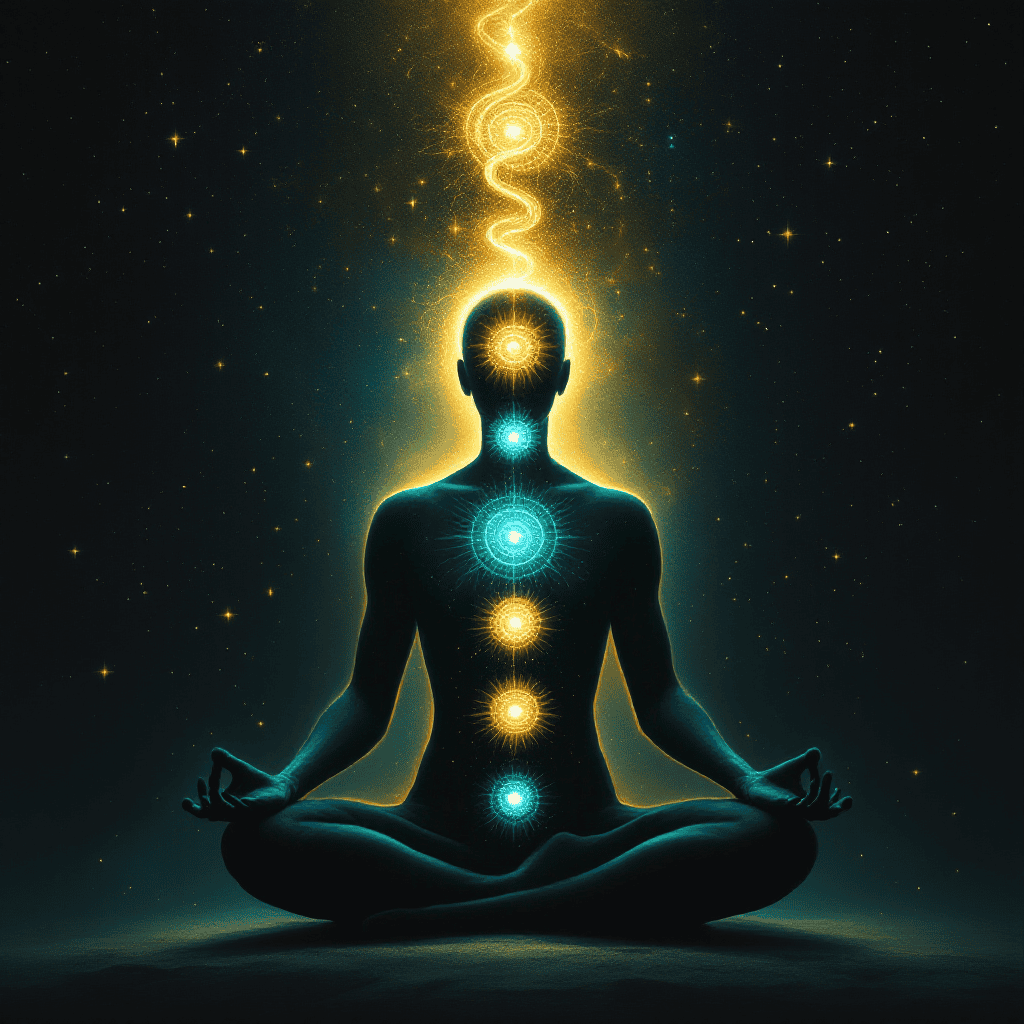
Kundalini awakening stages mark the most profound journey a human being can undertake. This ancient map, preserved across yogic traditions for thousands of years, describes the ascent of sacred energy through the body’s vertical axis. Each stage corresponds to a specific energy center, or chakra, where dormant potential awakens into conscious awareness. The journey is not abstract mysticism. It is a biological process encoded in the spine, the glands, and the nervous system itself.
What the yogis called kundalini, the Egyptians encoded as the Djed pillar. The Hebrews preserved it as Jacob’s ladder. The Christians recorded it in the stations of the cross. Different names. One architecture. And that architecture runs through your body right now, waiting for the conditions that allow it to rise.
What Is Kundalini?
The word kundalini means “coiled one” in Sanskrit. It refers to a dormant spiritual energy that rests at the base of the spine, often symbolized as a serpent coiled three and a half times around the sacrum. This is not metaphor. The sacrum, derived from the Latin os sacrum meaning “sacred bone,” was recognized by ancient anatomists as the foundation of the body’s spiritual current. When awakened through breath, discipline, meditation, or sudden spiritual experience, this energy begins its ascent through the central channel of the spine.
The yogic map describes seven primary chakras along this vertical pathway. Each serves as a gate where energy must be purified and integrated before rising further. The stages of kundalini awakening correspond to the opening of these gates, one by one, as the current moves from the root to the crown. What begins as instinctual survival energy at the base transmutes into divine awareness at the summit.
Modern neuroscience has begun mapping what the ancients described symbolically. The central nervous system and endocrine glands sit precisely where the chakras were mapped thousands of years ago. The pineal gland, positioned at the crown center, regulates circadian rhythms and has been linked to states of expanded awareness. The pituitary, the body’s master endocrine regulator, governs growth and hormonal balance. The heart generates the body’s strongest electromagnetic field. What the yogis saw from within, science now measures from without.
Stage One: Root Chakra Activation
The first stage of kundalini awakening begins at the root chakra, called Muladhara in Sanskrit. Located at the base of the spine, this center governs survival instincts, physical vitality, and the sense of safety in the material world. When kundalini stirs at this level, the seeker often experiences physical sensations: warmth or tingling at the base of the spine, spontaneous energy surges, or a sudden awareness of the body’s electromagnetic field.
This stage demands grounding. The rising energy must have a stable foundation or it scatters. Practitioners report feeling more present in their bodies, more connected to the earth, and more aware of their basic needs. Fear patterns that once controlled behavior begin to surface for release. The root does not ask for transcendence. It asks for embodiment. Only when survival energy is mastered can the current move upward.
The adrenal glands, which sit atop the kidneys, correspond to this center. They regulate the body’s stress response and produce cortisol, the hormone of fight or flight. When the root chakra stabilizes, the adrenals find balance. Chronic anxiety gives way to calm presence. The body learns it is safe to rise.
Stage Two: Sacral Chakra Opening
As the kundalini energy ascends, it reaches the sacral chakra, known as Svadhisthana. This center sits below the navel and governs creativity, desire, pleasure, and the generative life force. The second stage of awakening brings powerful shifts in how the seeker relates to desire itself. Sexual energy intensifies, not as distraction but as raw creative potential seeking direction.
Many traditions emphasize restraint at this stage. The reason is practical. Sexual release disperses the rising current back downward. What could have fueled ascent is spent in momentary pleasure. This is not moral judgment. It is energetic mechanics. The same force that creates new life externally can, when redirected inward, regenerate consciousness itself.
The reproductive organs correspond to this chakra. In men, the testes produce testosterone. In women, the ovaries regulate estrogen and progesterone. When the sacral center opens, creativity flows not only through procreation but through art, vision, and the capacity to birth new forms of expression. Emotions become fluid rather than stuck. The practitioner learns to channel desire upward rather than outward.
Stage Three: Solar Plexus Transformation
The third stage centers at Manipura, the solar plexus chakra. Located above the navel, this is the seat of personal power, willpower, and identity. When kundalini reaches this gate, the ego faces its first true test. Every limiting belief, every false identity, every need for external validation rises to the surface. The solar plexus fire burns away what no longer serves.
Practitioners describe this stage as both empowering and destabilizing. On one hand, confidence surges. The ability to set boundaries strengthens. On the other, old patterns of control and manipulation become unbearable. The practitioner can no longer live inauthentically. The solar plexus demands alignment between inner truth and outer action.
The pancreas, which regulates blood sugar and digestive enzymes, corresponds to this center. Metabolic balance reflects energetic balance. When the solar plexus stabilizes, digestion improves, energy steadies, and the practitioner stops operating from a place of depletion. Willpower is no longer forced. It flows naturally from a core that knows its own strength.
Stage Four: Heart Chakra Coherence
The fourth stage of kundalini awakening is the opening of Anahata, the heart chakra. This is the central fulcrum of the entire system. Three centers below govern the physical and personal self. Three centers above govern the spiritual and transpersonal. The heart bridges them. When kundalini reaches the heart, the seeker experiences a profound shift from ego-based consciousness to love-based awareness.
Compassion arises not as effort but as the natural state. Forgiveness becomes effortless. The boundaries between self and other soften. Many describe this stage as the first taste of unity consciousness. The heart does not erase individuality. It reveals that individuality exists within a greater whole. Connection replaces separation as the fundamental truth.
Research from the HeartMath Institute has documented that the heart generates an electromagnetic field extending several feet beyond the body. This field shifts measurably with emotional state. Gratitude, care, and appreciation produce coherent, ordered wave patterns. Fear and anger produce chaotic, disordered ones. The heart is not only a pump. It is a broadcast system. When the heart chakra opens, the practitioner begins radiating coherence that others can feel.
The thymus gland, positioned behind the sternum, corresponds to the heart center. In children it is large and active, governing immune development. In adults it often shrinks. Some researchers believe heart chakra activation may stimulate thymus function even in adulthood, supporting immune resilience and vitality. The connection between love and healing is not sentimental. It is physiological.
Stage Five: Throat Chakra Expression
The fifth stage involves the throat chakra, Vishuddha, the center of truth and expression. When kundalini energy reaches the throat, the practitioner can no longer remain silent. What was suppressed must be spoken. What was false must be corrected. The voice becomes an instrument of alignment, no longer willing to participate in deception or people-pleasing.
This stage often brings challenges in relationships. Friends and family accustomed to the old version of the seeker may resist the new authenticity. Jobs requiring compromise of values become unbearable. The throat chakra does not ask for aggression. It asks for integrity. The practitioner learns to speak truth without violence, to express boundaries without cruelty.
The thyroid gland, which regulates metabolism and energy levels, corresponds to this center. Thyroid imbalance often reflects suppressed expression. When the throat chakra opens, many practitioners report improvements in thyroid function. The voice that was silenced begins to resonate at its natural frequency. Sound becomes medicine. Chanting, toning, and mantra practice amplify the opening.
Stage Six: Third Eye Illumination
The sixth stage is the activation of Ajna, the third eye chakra, positioned between the eyebrows. This is the seat of intuition, inner vision, and direct knowing. When kundalini reaches this center, perception expands beyond the five physical senses. The practitioner begins seeing patterns, symbols, and connections invisible to ordinary awareness. Dreams become vivid and prophetic. Synchronicities multiply.
This stage can be disorienting. The rational mind struggles to categorize experiences that don’t fit its models. Some practitioners report seeing auras, energy fields, or geometric light patterns behind closed eyelids. Others describe a sense of witnessing consciousness itself, observing thoughts and emotions from a place beyond them. The third eye does not replace logic. It adds dimension.
The pineal gland, a small pinecone-shaped structure deep in the brain, corresponds to the third eye. It produces melatonin, regulating sleep-wake cycles, and contains light-sensitive cells similar to those in the retina. Some researchers speculate it may produce trace amounts of DMT, the molecule associated with mystical visions. Whether or not that hypothesis holds, the pineal’s role in regulating consciousness is undeniable. When the third eye opens, the inner anointing process reaches its penultimate stage.
Stage Seven: Crown Chakra Union
The seventh and final stage is the opening of Sahasrara, the crown chakra at the top of the head. When kundalini reaches the crown, the sense of being a separate self dissolves. What remains is pure awareness, undivided and infinite. The Hindus call it samadhi. The Buddhists call it nirvana. The Christians call it unity with God. The language changes. The experience does not.
This stage is not the end of the path. It is the beginning of a new way of living. The practitioner does not leave the world. The practitioner re-enters it as a vessel of coherence. Actions arise from stillness. Decisions come from clarity. The crown opening is not an escape. It is an embodiment of what was always true but hidden beneath distortion.
The pituitary gland, positioned just below the pineal, works in concert with it to produce what ancient traditions called the milk and honey. The pituitary releases oxytocin, vasopressin, and growth hormone. When it harmonizes with the pineal’s secretions, the result is a cascade of neurochemical coherence that floods the entire system. This is the inner resurrection described across mystery schools for millennia.The complete mechanism involves REDACTED, READ CHAPTER 21, timed to the body’s own lunar rhythms and supported by specific fasting protocols detailed in the full text.
Signs and Symptoms of Kundalini Rising
Kundalini awakening stages do not always unfold in linear sequence. Some practitioners experience spontaneous openings across multiple centers simultaneously. Others move gradually, spending months or years at each gate. The signs vary by individual but share common threads.
Physical symptoms include heat or tingling along the spine, spontaneous body movements or kriyas, changes in sleep patterns, and shifts in dietary preferences. Emotional symptoms include the surfacing of repressed memories, sudden mood swings, waves of bliss or despair, and the dissolution of old relationship patterns. Mental symptoms include vivid dreams, synchronicities, expanded intuition, and difficulty concentrating on mundane tasks. Spiritual symptoms include a sense of purpose, direct knowing without reasoning, compassion for all beings, and the recognition of the divine in everything.
Not all symptoms are pleasant. Kundalini rising through an unprepared vessel can produce overwhelm, anxiety, insomnia, and even physical pain. This is why every tradition that preserved this teaching also preserved the importance of purification. Dietary discipline clears the physical vessel. Breathwork regulates the nervous system. Meditation stabilizes the mind. Without preparation, the current has nowhere to go. It crashes into blockages and creates turbulence.
The Role of Purification and Discipline
Kundalini awakening is not a random event. It is a biological response to specific conditions. The body must be clean. The mind must be still. The emotions must be balanced. Ancient yogis spent years preparing the vessel before attempting to raise the serpent fire. Modern seekers often try to rush the process and pay the price in destabilization.
Fasting is one of the oldest preparation methods. When food intake stops, the body shifts from digestion to repair. Autophagy, the cellular recycling process, clears accumulated toxins and damaged proteins. The nervous system quiets. Energy redirects from the gut to the brain. Every major spiritual tradition prescribes periodic fasting because it creates the internal conditions kundalini requires to rise safely.
Sexual restraint is another consistent instruction. The same energy that creates new life externally can, when conserved, fuel the ascent of consciousness. This does not mean permanent celibacy. It means conscious direction of generative force. During active kundalini practice, many traditions recommend periods of abstinence to preserve the upward current. Ego dissolution practices support this by reducing compulsive desire at its root.
Breathwork directly influences kundalini flow. Pranayama, the yogic science of breath control, includes techniques designed to stimulate the central channel and activate dormant energy. Alternate nostril breathing balances the left and right currents. Breath retention builds internal pressure that helps the energy ascend. Rapid breathing techniques like Kapalabhati clear blockages and generate heat. The breath is the lever. Consciousness rides on it.
Kundalini and the Sacred Secretion
The rising of kundalini parallels another process encoded across mystery traditions: the sacred secretion. In yogic terms, this is the refinement of ojas, the subtle essence produced when vitality is preserved rather than scattered. In Christian mysticism, it is the Christos oil, a substance believed to descend from the brain and ascend the spinal column when the body is purified. In Taoist alchemy, it is the inner elixir of immortality.
The process involves cerebrospinal fluid, the clear liquid bathing the brain and spinal cord. When the body enters deep states of coherence through fasting, meditation, and discipline, the composition of this fluid shifts. Neuropeptides, hormones, and signaling molecules concentrate. The pineal and pituitary glands secrete substances that, when combined, produce what the ancients called the nectar of the gods. This is not folklore. It is endocrinology described in symbolic language.
The timing of this process follows lunar and solar rhythms. For men, the new moon. For women, the follicular phase. The secretion descends from the claustrum, a thin sheet of neurons hidden deep in the brain, and travels down the spinal column. If preserved through discipline, it ascends again, reaching the upper chamber where it activates the pineal gland. The result is a flood of inner light, the opening of the single eye, and the direct experience of unity consciousness. The mechanism is detailed in REDACTED, READ CHAPTER 21, including the specific fasting windows, breathwork protocols, and dietary restrictions that optimize the ascent.
Common Challenges and How to Navigate Them
Kundalini awakening is not without risk. The energy is real, and when it meets blockages in the system, the results can be destabilizing. Practitioners report physical pain, emotional breakdowns, relationship dissolution, and profound disorientation. These are not signs of failure. They are signs that the current is encountering resistance.
Grounding practices become essential. Walking barefoot on earth, spending time in nature, eating root vegetables, and engaging in physical labor all help anchor the rising energy. Without grounding, the practitioner can become unmoored, lost in visions and insights with no capacity to integrate them into daily life. The goal is not to escape the body. The goal is to illuminate it.
Community support matters. Kundalini awakening can be isolating. Friends and family who have not walked this path often cannot understand what the practitioner is experiencing. Finding teachers, mentors, or fellow seekers who have navigated these stages provides guidance and reassurance. The path is ancient, and while each journey is unique, the terrain is well-mapped.
Patience is non-negotiable. Forcing the process leads to what yogis call kundalini syndrome: premature activation without adequate preparation. Symptoms include chronic fatigue, nervous system dysregulation, and psychological fragmentation. The remedy is the same as the prevention: slow down, purify the vessel, and allow the body to set the pace. The energy knows where it is going. The ego’s job is to get out of the way.
Integration: Living as an Awakened Being
The final kundalini awakening stages are not endpoints but gateways. Once the crown opens, the work shifts from ascending to integrating. The practitioner must learn to hold the expanded awareness while functioning in the material world. Bills still need to be paid. Relationships still require attention. The body still needs care.
Integration involves bringing the insights of the upper chakras down into the lower ones. Spiritual vision without grounded action is escapism. Compassion without boundaries is depletion. The fully integrated being operates from coherence at every level: rooted in the earth, open at the crown, and radiating from the heart. This is not sainthood. It is wholeness.
The process is cyclical, not linear. Even after full crown activation, practitioners return to earlier stages to clear deeper layers. The root chakra reveals new patterns. The heart opens wider. The third eye refines its perception. Awakening is not a single event but a spiral, returning to the same themes at higher octaves. Each pass through the cycle brings greater clarity, stability, and embodiment.
What the yogis preserved for thousands of years is now available to anyone willing to walk the path. The body is the temple. The spine is the ladder. The glands are the altar. And the practice is the key. No guru required. No institution needed. The blueprint is written into your biology. The only question is whether you are ready to activate it.
Precautions and Contradictions
Kundalini awakening is a profound process that should not be approached casually. Certain conditions make it unsafe to pursue active kundalini practices without professional guidance. Individuals with a history of psychosis, severe mental illness, uncontrolled epilepsy, or trauma-related dissociation should consult qualified mental health professionals before engaging in intensive breathwork, meditation, or fasting protocols. The energy can amplify existing instability.
Pregnant women and individuals with serious medical conditions should approach these practices with caution and medical supervision. Fasting during pregnancy is not recommended. Certain breathwork techniques can affect blood pressure and heart rhythm. Always consult a healthcare provider before making significant changes to diet, exercise, or spiritual practice.
The goal is not to force an experience but to create conditions where natural unfoldment can occur safely. Preparation, purification, and patience are not obstacles to awakening. They are the foundation that makes sustainable awakening possible. The path is ancient. The body is wise. Trust the process, respect the stages, and honor the vessel carrying you through them.
The Path Forward
Kundalini awakening stages represent the most complete map of human transformation ever preserved. From the root to the crown, each gate opens a new dimension of perception, power, and presence. The journey is biological, psychological, and spiritual simultaneously. It demands everything and offers even more. The reward is not escape from life but full participation in it as a conscious, coherent, awakened being.
The teachings were hidden for centuries because the awakened individual becomes ungovernable. Institutions cannot control someone operating from direct knowing rather than belief. Hierarchies collapse when the intermediary is no longer needed. This is why the serpent was demonized, the oil forgotten, and the inner path obscured. Yet the knowledge survived. Encoded in temples, preserved in texts, and most importantly, written into the design of every human body. You carry the map. The spine is the ladder. And the only permission you need is your own discipline to walk it.